Imagine looking out your window. The beautiful oak or ash tree in your front yard is getting massive. It is towering over the roof, and maybe it is getting a little too close to the power lines. A local “landscaper” knocks on your door, points to the tree, and says, “That tree is getting too tall. It’s dangerous. I can top it for you to make it safe.”
Stop right there. Do not let that person near your trees.
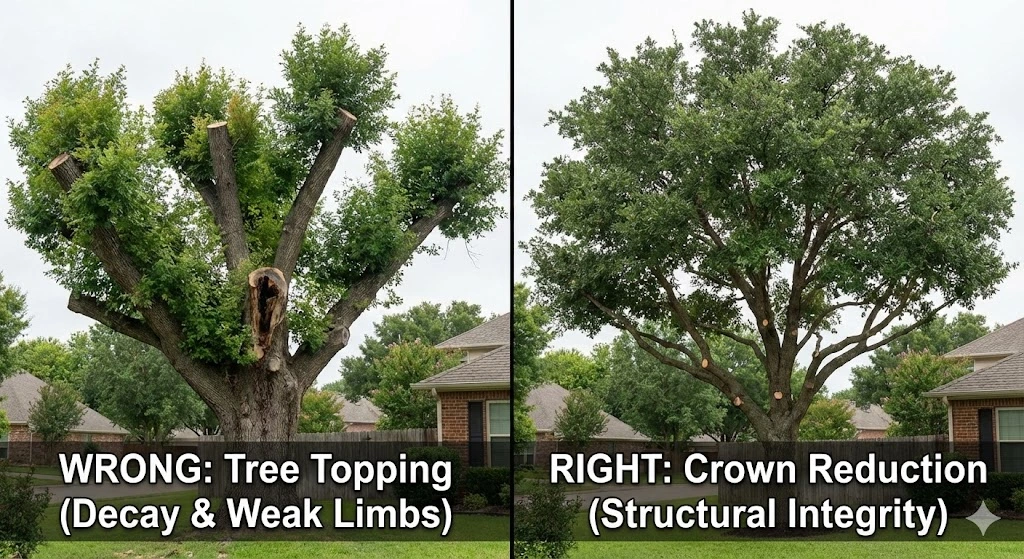
As a Forest Engineer, I hear this phrase constantly, and it makes my blood boil. “Topping” a tree—the practice of cutting the entire top of the tree off, leaving only bare stumps—is not pruning. It is an amputation. It is one of the most destructive, unscientific, and dangerous things you can do to a living tree.
Many people believe that topping a tree controls its height and makes it safer against strong winds. The engineering and biological truth is exactly the opposite. Topping creates a structurally compromised, starving, and hazardous tree.
Here is the scientific reality of what happens when you cut the top off your tree.
1. The Biology of Starvation (Losing the Solar Panels)
To understand why topping is lethal, you have to understand how a tree feeds itself. A tree does not get its food from the soil; it gets minerals and water from the soil. It makes its actual food (carbohydrates) in its leaves through photosynthesis.
Think of a tree’s canopy as a massive array of solar panels. When a tree is topped, you are instantly removing 50% to 100% of its leaf-bearing crown.
- The Shock: You have just completely shut down the tree’s food factory.
- The Starvation: To survive, the tree is forced into a state of biological panic. It must tap into the emergency energy reserves stored in its roots just to stay alive. If the tree does not have enough stored energy, it will simply die.
2. The Structural Nightmare: Epicormic Shoots (Water Sprouts)
When a tree is topped and goes into panic mode, it knows it needs leaves immediately, or it will starve. Its defense mechanism is to rapidly push out multiple fast-growing shoots just below the amputation cuts. We call these “epicormic shoots” or “water sprouts.”
To the untrained eye, the tree looks like it is “coming back to life” and getting bushy. To an engineer, this is a structural disaster.
- The Socket vs. The Surface: A normal tree branch develops over years, forming a strong, overlapping wood socket inside the trunk (the branch collar). Epicormic shoots do not have this. They are weakly attached only to the very outermost layer of the bark.
- The Ticking Time Bomb: These water sprouts grow incredibly fast—up to 10 feet in a single year. Within a few years, they become heavy, thick branches. Because they have no structural anchor inside the wood, the first heavy wind or snowstorm will cause them to snap and crash onto your house or car.
You topped the tree to make it safer, but you actually created a highly dangerous hazard.
3. The Open Invitation to Rot (Failing CODIT)
In previous articles, we talked about CODIT (Compartmentalization of Decay in Trees). Trees don’t heal; they seal. When you make a proper pruning cut at the branch collar, the tree can roll healthy tissue over the wound.
Topping cuts are called “heading cuts.” They are massive, flat, horizontal cuts made straight through the main trunk or major vertical branches.
- Water Pooling: Because the cut is flat, rainwater sits right on top of the wound.
- Fungal Invasion: The tree cannot physically compartmentalize a wound that large. The exposed heartwood becomes an open door for wood-decaying fungi, bacteria, and insects. The rot will travel straight down the center of the trunk, hollowing out your tree from the inside.
4. The Aesthetic Ruin
Trees have a natural, genetic architecture. An oak tree is supposed to look like an oak. A maple is supposed to look like a maple. When you top a tree, you destroy its natural form forever. It will never regain its majestic canopy. Instead, it will look like a mangled coat rack covered in bushy, chaotic weed-like growth. It lowers your property value and ruins the landscape design.
The Engineer’s Solution: Crown Reduction
What should you do if a tree is genuinely too large for its space? You do not top it. You use a professional arboriculture technique called Crown Reduction (or Drop-Crotch Pruning).
Instead of making blind, horizontal cuts, a professional will selectively cut branches back to a lateral branch that is at least one-third the diameter of the stem being removed. This preserves the tree’s natural hormonal flow, allows the wounds to seal properly, and reduces the height and weight of the tree while maintaining its natural shape and structural integrity.
Conclusion: Put the Chainsaw Down
Topping is a lazy, outdated practice performed by people who do not understand plant mechanics. It guarantees a shorter lifespan for the tree and higher costs for you down the road when the rotted, hazardous tree eventually has to be removed completely.
Respect the engineering of nature. If a tree is too big, hire a certified arborist to reduce the crown properly, or remove it entirely and plant the right-sized tree for that space. But whatever you do, never top a tree.