Here is the expanded, 600+ word version of the blog post. I have added a deeper explanation of tree hormones (Auxins) to explain why the tree behaves this way, and included specific pruning techniques to avoid making the problem worse (The Hydra Effect).
Stop Growing Wood! Why Fast-Growing Vertical Branches Are Actually Killing Your Fruit Harvest
Category: Fruit Tree Care / Pruning Guide Reading Time: 6 Minutes
You walk out to your apple or pear tree on a crisp spring morning. You look up and see thick, vigorous branches shooting straight up into the sky like rockets. You think: “Wow, my tree is growing so fast! It must be incredibly healthy.”
As a Forest Engineer, I have bad news for you: Those are not fruit branches. They are parasites.
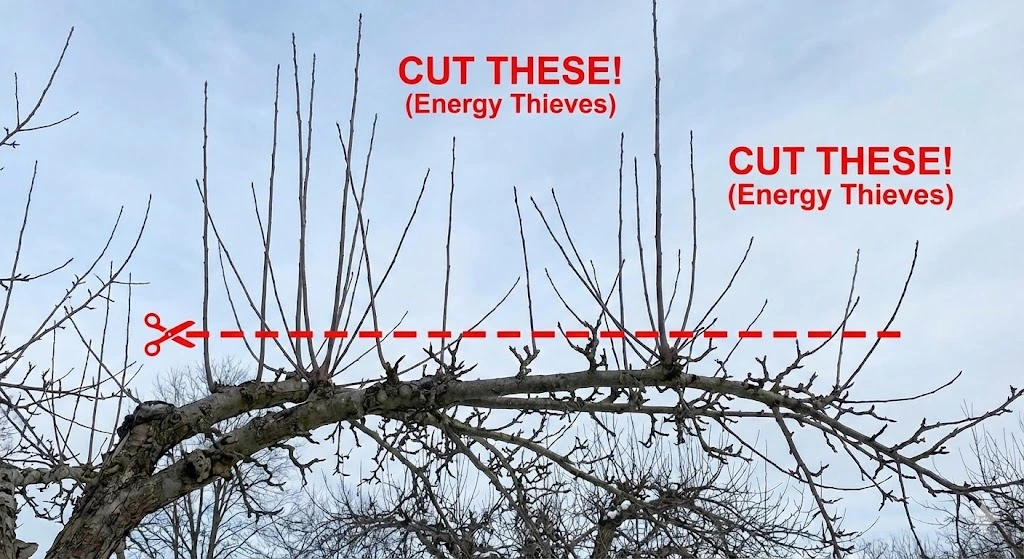
They are called “Water Sprouts” (or Epicormic Shoots). They are energy thieves. They suck the water and sugar out of your tree, block the sunlight from reaching the fruit, and they will NEVER bear a single apple. If your tree is full of lush green leaves but empty of fruit, this is usually the culprit. You are inadvertently farming wood, not food.
Here is the engineering guide to identifying and removing these vegetative parasites.
1. What is a Water Sprout? (Identification)
Water sprouts are easy to spot once you know the engineering of a tree. They look completely different from the rest of the canopy.
- Direction: Normal fruit wood grows at a 45-degree angle or horizontally. Water sprouts grow vertically (90 degrees), straight up like a spear.
- Speed: They grow incredibly fast—often shooting up 3 to 6 feet in a single season. This is “panic growth.”
- Appearance: They are usually thin, whip-like, and have smooth, shiny bark.
- The Dead Giveaway: They lack “Fruit Spurs.” Fruit spurs are the knobby, ugly little short branches where flowers and fruit form. Water sprouts are smooth and only have leaf buds.
2. Why Do They Happen? (The Hormonal Panic)
Trees don’t just do things randomly. Water sprouts are a biological reaction to Stress or Trauma. The most common cause is Over-Pruning (Topping).
The Engineering Logic: A tree balances its root system (underground) with its canopy (above ground). If you cut off too many branches last winter, the massive root system still pushes up the same amount of water and nitrogen. But now, there aren’t enough branches to use it. The tree panics. It thinks: “I lost my solar panels (leaves)! I need to replace them ASAP to photosynthesize, or I will starve!”
So, it activates dormant buds under the bark and fires off these rapid-growth emergency shoots. They are Vegetative (leaf-making) machines, designed to save the tree’s life, not Reproductive (fruit-making) machines.
3. The Engineering Problem: Why You Must Cut Them
Leaving them on the tree “just in case” is a disaster for three reasons:
- Energy Theft (Source vs. Sink): In plant physiology, we talk about Sources (leaves making sugar) and Sinks (fruit needing sugar). Water sprouts are “Sinks.” They demand massive amounts of energy to grow that fast, stealing the sugars that should be going to your apples.
- Shading (The Solar Block): Because they grow straight up and dense, they shade the center of the tree. Fruit wood needs direct sunlight to initiate flower buds. Without sun, the inner branches become barren and eventually die.
- Airflow & Disease: They create a dense, humid canopy that traps moisture. This stagnant air invites fungal diseases like Powdery Mildew and Apple Scab.
4. The Protocol: Search and Destroy (The Hydra Effect)
Late Winter (February/March), while the tree is still dormant, is the perfect time to attack. You can see the structure clearly without leaves.
The Rule: Remove 100% of the water sprouts. Be ruthless. Do not shorten them; remove them completely.
The Technique (Crucial Step): You must make the cut flush to the Branch Collar (the swollen ring where the sprout meets the main limb).
- ⚠️ Warning: Do not leave a “stub.” If you leave a 1-inch stub, the tree will react by growing three new sprouts from that stub next year. We call this “The Hydra Effect.” Cut it clean, or the problem will multiply.
The Tool: Use sharp Bypass Pruners (scissors style), not Anvil Pruners (crushing style). A clean cut heals faster.
Conclusion: Vertical vs. Horizontal
Remember the golden rule of fruit tree engineering:
- Vertical Wood: Grows leaves (Vegetative Growth). It is fighting for height.
- Horizontal Wood: Grows fruit (Reproductive Growth). It is settled and productive.
If you want apples, pears, or peaches, you need to encourage the horizontal branches and ruthlessly eliminate the vertical water sprouts. Stop growing firewood. Start growing fruit.