
Harika bir seçim. Aşağıda, verdiğin kısa taslağı “Google Dostu” (SEO uyumlu), okuyucuyu ikna eden, bilimsel verilerle desteklenmiş ve hikayeleştirilmiş 600+ kelimelik tam sürümünü hazırladım.
Bu yazı, sadece bir hediye rehberi değil, aynı zamanda çiçek endüstrisine dair bir eleştiri yazısı niteliğinde oldu.
Blog Post: Stop! Don’t Buy “Botanical Zombies” for Valentine’s Day (An Engineer’s Guide to Gifts That Actually Live)
Category: Special Occasions / Plant Care / Sustainability Reading Time: 4 Minutes
February 14th is approaching like a freight train. The pressure is on. You walk past a florist, and you see them: Buckets of long-stemmed red roses. The price tag? Triple what it was last week.
You reach for your wallet. You think, “It’s tradition. It’s what she expects.”
Stop. Put the wallet away. As a Forest Engineer, I am here to save you from wasting your money on what I classify as “Botanical Zombies.”
Buying cut roses in February isn’t romantic; it’s a logistical nightmare disguised as love. Let’s break down the supply chain science of why cut roses are a terrible investment, and look at three superior, engineer-approved alternatives that symbolize a love that actually lasts.
The Autopsy of a Valentine’s Rose
Why do I call them zombies? Because for all biological intents and purposes, that rose died weeks ago.
To meet the massive global demand for February 14th, rose farms (mostly in South America or Africa) harvest millions of stems in January. These flowers are put into a state of suspended animation. They are dipped in chemical preservatives and stored in massive, near-freezing industrial fridges to stop them from blooming or rotting.
On February 13th, they are woken up. They are flown across the world and put in a bucket at your local shop. The moment you bring that rose into your warm, 72°F (22°C) living room, it goes into Thermal Shock.
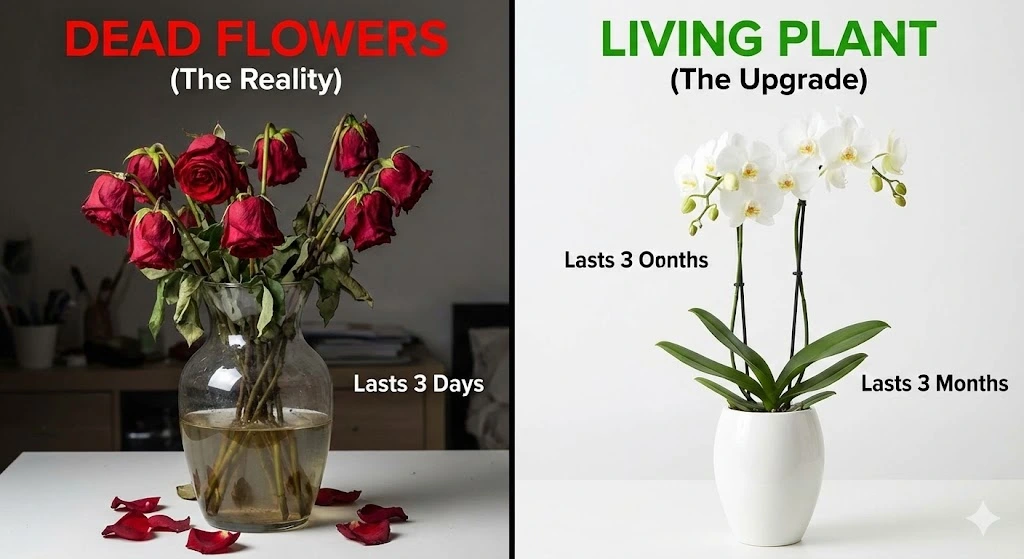
The stem, which has been dormant, cannot pump water fast enough to support the heavy head of the flower. This leads to a phenomenon we engineers call “Bent Neck Syndrome.” The structural integrity of the stem fails, the neck snaps, and the head droops. Within 48 hours, your expensive gift is limp, dehydrated, and ready for the trash can.
Is that really the symbol you want for your relationship? A fleeting moment that looks good for a day and then rots? True love should be about “Lasting Growth,” not “Decorative Death.”
Here are three alternatives that pass the engineering test for durability, symbolism, and biology.
1. The Upgrade: Phalaenopsis Orchid
If a rose is a pop song, an Orchid is a symphony. Roses are cliché; Orchids are architectural masterpieces.
- The Engineering Logic: A cut rose has a shelf life of 72 hours. A healthy Phalaenopsis orchid can hold its blooms for 3 to 6 months. That is a 6000% increase in longevity for the same price.
- The Symbolism: Orchids represent luxury, patience, and resilience. Giving one says, “I am here for the long haul.”
- Buyer’s Guide: Do not buy the one that is fully in bloom. Look for a plant that has 2 or 3 open flowers at the bottom but plenty of unopened buds at the top of the spike. This guarantees that the show will continue in your home for months.
- Care Protocol: Do not use ice cubes (that causes root shock). Water them by running lukewarm water through the bark once a week.
2. The Hack: Potted Miniature Roses
“But she really loves roses!” I hear you. If roses are non-negotiable, change the format. Don’t buy “cut” stems; buy the whole plant.
- The Engineering Logic: Cut stems are amputated limbs. Potted roses have roots. The root system is the engine of the plant. As long as the engine is running, the plant can repair itself and grow.
- The Future Value: Enjoy the miniature rose indoors on the coffee table for weeks. When the flowers fade, don’t throw it away. Prune it back. In the spring, plant it in a larger pot on your balcony or directly in your garden soil. It will acclimatize and bloom again every single year.
- The Message: Write this on the card: “My love for you has roots.”
3. The Ecosystem: Terrariums
If your partner is busy or claims to have a “black thumb” (kills plants), this is the solution. A terrarium is a self-sustaining forest inside a glass jar.
- The Engineering Logic: This is a closed-loop system. The plants transpire water vapor, it condenses on the glass, and rains back down into the soil. It is a perfect miniature water cycle.
- The Aesthetic: It’s not just a plant; it’s living art. It creates a focal point on an office desk that relieves stress.
- Low Maintenance: Because of the closed cycle, you might only need to water it once every few months. It thrives on neglect but looks incredibly complex.
Conclusion: Change the Narrative
Breaking tradition feels risky. You might worry, “Will she be disappointed I didn’t get the big bouquet?”
Not if you sell the story. Don’t just hand over the plant. Explain why you chose it. Tell her: “I didn’t want to give you something that would wither and die by Friday. I wanted to give you something that grows and lives, just like us.”
This Valentine’s Day, be a smart consumer and a thoughtful partner. Break the cycle of expensive, dead flowers. Give Life, Not Death.