When the leaves of that century-old plane tree in your garden, the walnut tree you grew up under, or the apple tree you’ve been waiting to harvest start to turn yellow, what is your first thought? For most garden owners, this is a moment of panic. Usually, the sentence “This tree is drying out, let’s cut it down and plant a new one” becomes that tree’s death warrant.
Stop. Put down the axe.
As a Forest Engineer, I can tell you this: A tree shedding leaves, suffering from bark wounds, or under insect attack is not “dead”; it is simply a “patient.” And just like a sick human, it can be brought back to life with the right diagnosis and modern medical interventions.
We call this “Tree Surgery.” Today, I will explain how we “operate” on trees instead of cutting them down, using the rescue methods provided by modern science.
Introduction: Tree Triage and Diagnosis
Imagine walking into a hospital emergency room. A doctor doesn’t say “let’s operate” without looking at you. They run tests first. The process is the same for trees. A yellowing leaf is a cry for help, but the cause could be anything:
- Abiotic Stress: Drought, frost, improper pruning, or soil compaction.
- Biotic Stress: Fungi, bacteria, or harmful insects.
The first step to saving a tree is finding out why it is sick. If the roots are suffocating, spraying medicine on the leaves is useless. If there is fungus on the trunk, increasing watering will only feed the fungus. Engineering begins by solving this equation.
Operation 1: Trunk Injection (Endotherapy)
Forget the massive spray tankers you know about tree spraying and the toxic clouds drifting in the wind. In modern forestry, we use the tree’s own circulatory system.
Just beneath the bark of trees, there are tiny tubes called “Xylem” and “Phloem” that transport water and nutrients. This is exactly like the intravenous (IV) lines used in humans.
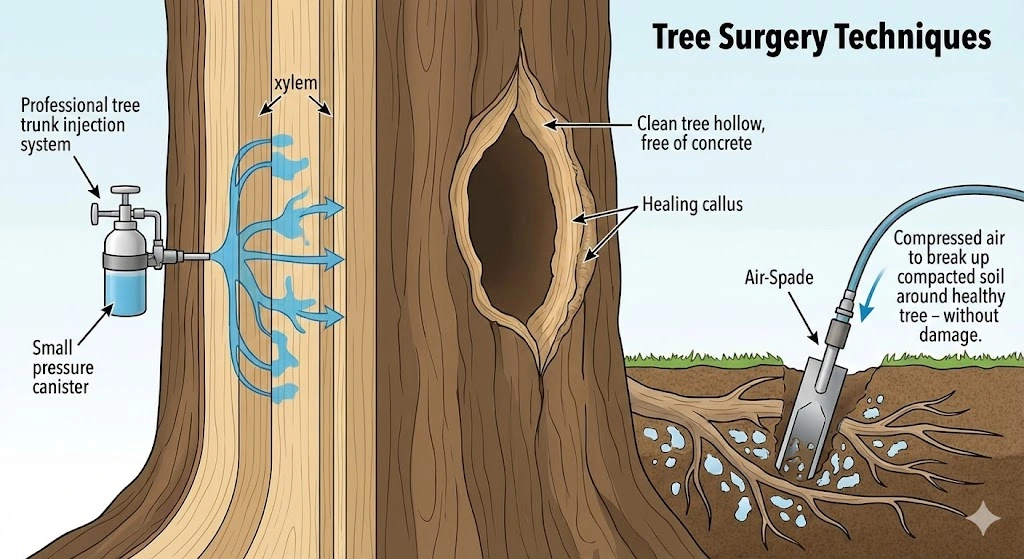
What is Endotherapy (Trunk Injection)? It is the injection of medication or nutrient supplements (fertilizer, iron, zinc, etc.) directly into the tree trunk using special pressurized tubes or micro-injectors.
Why This Method?
- Precision: The medication mixes into the tree’s system at a rate of 100%. It doesn’t wash off the leaves.
- Eco-Friendly: Not a single drop of chemical mixes with the soil, water, or air. It is completely safe for your children or pets playing in the garden.
- Fast Action: The medication is rapidly transported to the furthest leaf via the tree’s vascular system (transpiration stream).
Operation 2: Mechanical Cleaning & The “Concrete Filling” Myth
The biggest, most lethal mistake made in tree care is this: “Filling the tree hollow with concrete.”
Please, never do this.
Why Shouldn’t You Pour Concrete? Trees are living organisms that flex in the wind. Concrete is rigid and does not flex. When the wind blows, the concrete filling acts like sandpaper, abrading the tree’s internal tissue. Even worse, moisture accumulates in the gap between the concrete and the wood. This damp, dark environment is a 5-star hotel for fungi. While you think you are saving the tree, you are actually rotting it from the inside out.
What is the Correct Way? (The Surgical Intervention)
- Necrosis Cleaning: Decayed, softened tissue is scraped away using special tools until hard, healthy tissue is reached (just like a dentist cleaning a cavity).
- Sterilization: The cleaned area is disinfected with Bordeaux Mixture (Copper Sulfate) or special fungicides to purge fungi and bacteria.
- Ventilation: The hollow is NOT closed! The wound is kept airy and dry so the tree can repair itself (create callus tissue). If necessary, drainage channels are opened to allow water to flow out.
Operation 3: Root Aeration (Air-Spade Technology)
The number one killer of trees in the city isn’t insects or lack of water. The killer is: Soil Compaction.
Construction machinery, foot traffic, or parked cars cause the soil to harden like concrete. Tree roots cannot breathe. Yes, roots need oxygen too!
In traditional digging/tilling, you risk tearing the roots apart. This is where “Compressed Air (Air-Spade)” technology comes in.
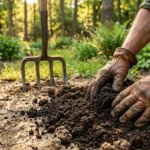
How is it Done? Using a special lance that blows air at supersonic speeds, the soil at the tree’s root collar is exploded. While the air disintegrates the soil, it causes zero damage to the flexible tree roots.
- Roots are exposed and inspected.
- “Girdling roots” that are strangling the tree are cut.
- The soil is enriched with perlite and organic matter and laid back over the roots. Result: The tree takes a deep breath, and its growth rate doubles.
Conclusion: The Tree’s Immune System (CODIT)
Trees do not “heal” like human skin. They “compartmentalize” the wound. Scientifically, we call this CODIT (Compartmentalization of Decay in Trees).
The surgical interventions we Forest Engineers perform are not to heal the tree ourselves, but to trigger the tree’s own defense system (CODIT). An intervention made at the right time can turn a drying tree into a legacy you leave for your grandchildren.
Don’t give up on that old tree in your garden. Maybe all it needs is the right surgery.