Every pruning season, millions of homeowners make a terrible economic and biological mistake. They spend their weekends cutting down overgrown branches, dragging them to the curb, and paying the municipality to haul them away.
Then, a month later, they drive to the garden center and spend hundreds of dollars buying plastic bags of generic wood mulch to put back into their gardens.
As a Forest Engineer, I look at this cycle and see a massive failure in efficiency. You are literally throwing away the exact organic matter your soil desperately needs. In forestry, we operate on a “closed-loop” system. What comes from the soil goes back to the soil.
The machine that bridges this gap is the Wood Chipper/Shredder. It is not just a power tool; it is a mulch-printing machine. By investing in the right chipper, you can turn a massive pile of nuisance branches into high-value organic mulch that retains soil moisture, suppresses weeds, and eventually breaks down into nutrient-rich compost.
However, buying the wrong chipper is an exercise in frustration. If you buy an underpowered machine, it will jam every five minutes. Here is my engineering guide to the mechanics of wood chipping, and the top 5 machines you should consider based on the size of your land.
The Engineering Mechanics: Chipper vs. Shredder
Before you buy, you must understand the physics inside the machine. Most residential machines are “Chipper/Shredders,” meaning they have two distinct cutting mechanisms in one housing:
- The Chipper Chute (For solid branches): This uses a heavy, spinning steel flywheel equipped with hardened steel knives. As you feed a branch in, the knives shave off slices of wood at high RPM. This requires massive torque.
- The Shredder Hopper (For leaves and twigs): This top-loading hopper drops soft material into a chamber filled with swinging metal “flails” or hammers. These hammers smash and pulverize soft, wet material until it is small enough to pass through a screen.
Rule of thumb: Never put soft, wet leaves into the chipper chute (it will clog), and never put thick hardwood branches into the shredder hopper (it will break the hammers).
The Top 5 Wood Chippers for Every Property
1. Best for Small Suburban Gardens: The Electric 15-Amp Chipper
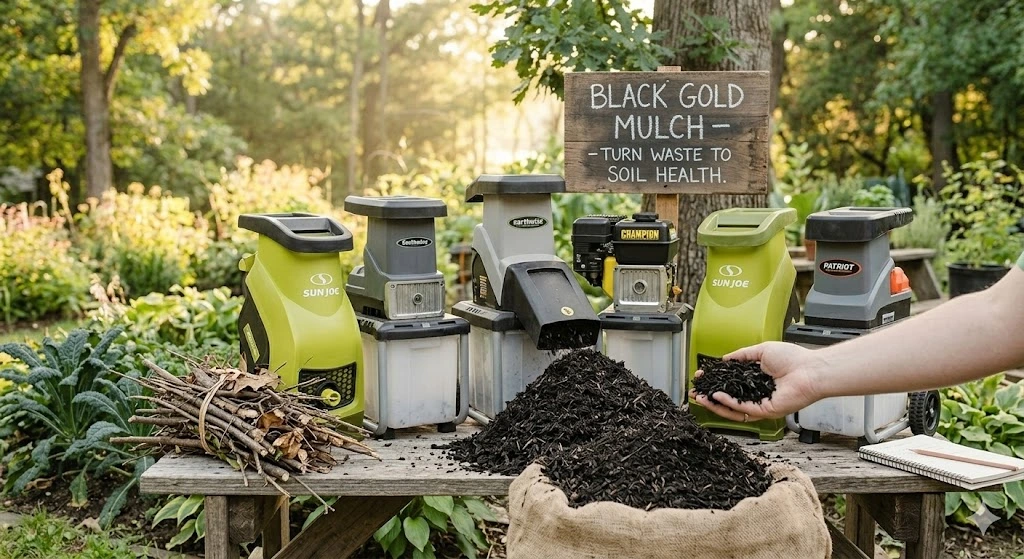
(Examples: Sun Joe CJ603E, Earthwise) If you have a small yard and only prune rose bushes, thin fruit tree branches, and small shrubs, you do not need a loud gas engine.
- The Engineering: These run on standard 110V/220V household electricity. They use a reduction gear mechanism that spins a cutting blade slower but with high torque.
- Capacity: Max 1.5 inches (4 cm) in diameter.
- Pros: Zero emissions, very quiet, zero engine maintenance (no oil or carburetors to worry about), and lightweight.
- Cons: They struggle with anything thicker than a broomstick. If you try to force dry, hard oak through this, you will burn out the electric motor.
2. Best All-Rounder for Homeowners: The 3-Inch Gas Chipper/Shredder
(Examples: Champion Power Equipment 3-Inch, SuperHandy) This is the “sweet spot” for 80% of property owners. Powered by a 200cc to 220cc 4-stroke gas engine, this machine provides the mechanical force needed to actually process a fallen tree.
- The Engineering: Direct-drive centrifugal clutch. The engine spins the heavy flywheel at high speeds, creating enough kinetic energy to slice through solid wood effortlessly.
- Capacity: Up to 3 inches (7.5 cm) for the chipper, 1/2 inch for the shredder hopper.
- Pros: It offers a 20:1 reduction ratio. A massive pile of brush the size of a car becomes a single wheelbarrow of premium mulch. Excellent mobility on pneumatic tires.
- Cons: Requires regular engine maintenance (oil changes, spark plugs, winterizing fuel).
3. Best for Heavy-Duty Acreage: The 4-Inch Commercial Gas Beast
(Examples: DK2 4-Inch, Patriot Products CSV-3100B) If you own several acres or a small woodland, a 3-inch chipper will slow you down. You need a machine with a larger engine (300cc+ or 14 HP) and a heavier flywheel.
- The Engineering: These often use a dual-belt drive system rather than direct drive. If a massive piece of wood jams the blade, the belts will slip, protecting the engine’s crankshaft from snapping. This is a crucial safety engineering feature for heavy loads.
- Capacity: 4 inches (10 cm) and above.
- Pros: Devours thick branches, wet wood, and heavy brush quickly. Gravity-feed chutes mean the machine pulls the wood in; you don’t have to push it.
- Cons: Heavy (often over 200 lbs) and expensive.
4. Best for Soft Waste & Composting: The Dedicated Leaf Mulcher
(Examples: WORX WG430) Sometimes, your problem isn’t branches; it’s a mountain of autumn leaves. Running leaves through a standard chipper is inefficient.
- The Engineering: Instead of heavy steel knives, these use a heavy-duty string trimmer mechanism (thick nylon lines) spinning at ultra-high RPMs to pulverize dry leaves into dust.
- Capacity: Leaves and very thin twigs only.
- Pros: Reduces 11 bags of leaves into 1 bag of finely chopped, nitrogen-rich compost material.
- Cons: Useless for actual wood or branches.
5. Best for Farm Owners: The PTO Tractor Attachment
(Examples: WoodMaxx, Titan Implements) If you already own a compact tractor for your land, do not buy a standalone gas chipper. Buy a PTO (Power Take-Off) driven chipper.
- The Engineering: These machines have no engine of their own. They connect to the rear drive shaft of your tractor, utilizing the tractor’s massive diesel engine to spin a giant, heavy-duty steel rotor.
- Capacity: 6 to 8 inches (15-20 cm).
- Pros: Industrial-level power. They feature hydraulic auto-feed rollers that grab the tree and pull it in at a controlled speed. This is true forestry equipment.
- Cons: You must own a tractor with a compatible PTO hp rating.
The Engineer’s Final Maintenance Rule
A wood chipper is only as good as its blades. Wood is an abrasive material. Over time, friction rounds off the edge of the steel chipping knives.
When the blades get dull, the machine stops cutting and starts beating the wood. This sends violent vibrations through the machine, shatters bearings, bogs down the engine, and makes the work physically exhausting for you.
Learn to remove the blades and sharpen them on a wet stone or bench grinder every season. A sharp blade reduces fuel consumption, saves the engine, and produces clean, uniform mulch that your garden will love.