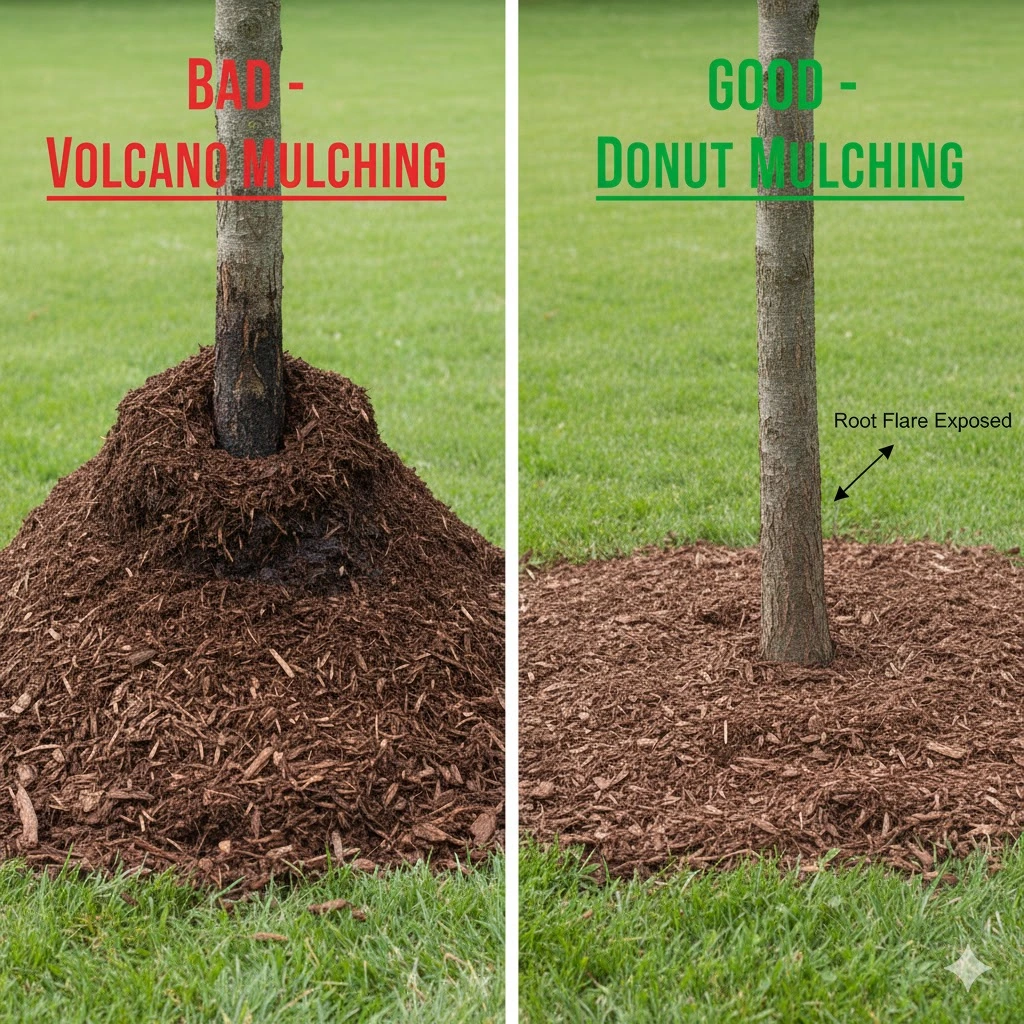
Take a walk around your neighborhood or drive through any commercial office park in America or Europe. You will likely see it everywhere: huge piles of fresh, colorful mulch mounded up high against tree trunks. They look exactly like miniature volcanoes.
To the untrained eye, it looks neat, professional, and well-maintained. It signals, “I care about my property.” As a Forest Engineer, I see something very different. I see a slow-motion disaster.
What you are seeing—and perhaps unknowingly doing—is called “Volcano Mulching.” It is the single most common and destructive landscaping mistake in modern horticulture. While your intentions are to protect and nourish the tree, you are actively suffocating it.
Let’s delve into the engineering of tree biology to understand why this popular practice is a silent killer, and how a simple shovel can save your trees.
1. The Biological Failure: Burying the “Lungs”
To understand why mulch volcanoes are deadly, you need to understand tree anatomy. Every tree has a critical zone where the vertical trunk widens and transitions into the horizontal root system. This area is called the “Root Flare” (or Root Collar).
The Engineering Truth:
- Root Bark vs. Trunk Bark: The bark on a tree’s roots is designed to be wet and absorb water. The bark on a tree’s trunk is designed to be dry and facilitate gas exchange (breathing).
- The Suffocation: When you pile 10 inches of mulch against the trunk, you trap moisture against tissues that are meant to be dry. This softens the bark, causing it to rot. It essentially suffocates the phloem cells (the inner bark) that transport food from the leaves to the roots.
- The Result: It is the biological equivalent of wearing a wet sock around your neck 24/7. Eventually, the skin rots. In trees, this invites fungal pathogens (like Armillaria root rot) and insect borers that feast on the decaying bark.
2. The Self-Strangulation: Stem Girdling Roots
This is the most insidious part of volcano mulching because it happens underground, unseen. Tree roots are opportunistic; they grow wherever they find moisture and oxygen.
The Mechanism: Normally, roots grow outward, away from the trunk. But when you create a mountain of moist, fluffy mulch right against the trunk, the tree gets confused. It thinks, “Oh, this mulch is soil!” The tree starts sending out new, tiny roots into the mulch pile. These roots grow around the trunk in a circle rather than growing out.
The Chokehold: As the tree grows in diameter, these circular roots get thicker and tighter. Eventually, they act like a tourniquet. They compress the trunk, cutting off the flow of water and nutrients. We call these “Stem Girdling Roots.” The tree literally strangles itself to death. You won’t see symptoms for years, until one day the tree’s canopy suddenly turns yellow and dies because its plumbing has been crushed.
3. The Solution: The “Donut” Method (The 3-3-3 Rule)
Mulch itself is fantastic. I love mulch. It insulates the soil, suppresses weeds, and retains water. The problem isn’t the material; it’s the geometry. Instead of a “Volcano,” you need to build a “Donut.”
The Engineering Standard (The 3-3-3 Rule):
- 3 Inches Deep: The layer of mulch should be no more than 3 inches (7-8 cm) deep. Any deeper, and you cut off oxygen to the soil.
- 3 Inches Away: The mulch must NEVER touch the tree trunk. Pull it back. You should always be able to see the flare where the trunk enters the ground.
- 3 Foot Ring: The mulch circle should extend at least 3 feet out from the trunk (the wider, the better) to minimize competition from grass.
Visual Check: If it looks like a pitcher’s mound, it’s wrong. If it looks like a flat donut with the tree in the empty center, it’s right.
4. The Rescue Mission: How to Fix a Volcano
Do you have trees that are currently buried? Don’t panic. You can fix this today.
Step 1: Excavation Use your hands or a small hand trowel. Carefully pull the mulch away from the trunk. Keep digging down until you find the Root Flare (the widening base).
Step 2: Assessment If the bark is slimy or soft, let it dry out. The air will help it harden. If you see small fibrous roots growing in the mulch pile around the trunk, cut them. They are bad roots. If you see a large root wrapping around the trunk (girdling root), you may need to carefully sever it with a chisel to relieve the pressure (consult an arborist for big roots).
Step 3: Re-Grading Spread the old mulch out into a wide, flat ring. Make sure the flare is exposed to the sunlight and air.
Conclusion: Let Them Breathe
Trees are resilient, but they cannot survive being buried alive. Next time you hire a landscaper, watch them. If they start piling mulch up the trunk, stop them. Tell them you want a “Donut,” not a “Volcano.” By making this one simple correction, you are adding decades to the life of your trees.