It is the same story every spring. You walk into a garden center or a big-box store, and you see them: The shiny, colorful “Gardening Starter Kits.”
They come in a nice box, maybe with a floral pattern on the handles. You get a trowel, a cultivator, and a transplanter all for $25. It seems like a bargain. You buy it, head home, and strike the earth with enthusiasm.
SNAP.
Five minutes in, the neck of the trowel bends backward like a cheap spoon in hard ice cream. Or worse, the handle snaps off completely. You are left holding a piece of plastic, while the metal part is buried in the dirt.
As a Forest Engineer, I don’t look at tools as “accessories.” I look at them as extensions of the human body designed to transfer force. When a tool fails, it’s not bad luck; it’s bad physics.
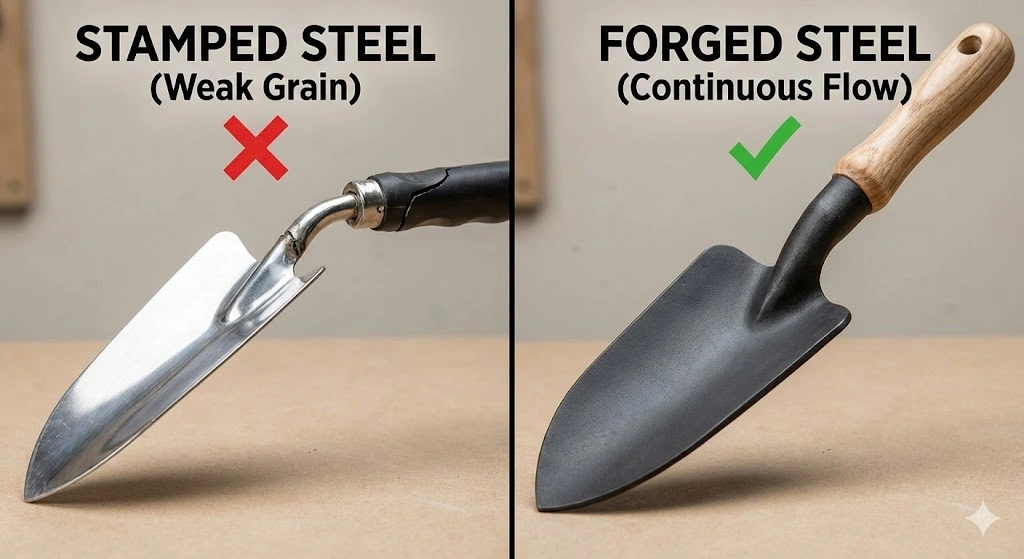
The reason your tools are breaking isn’t that your soil is too hard. It is because you are buying Stamped Steel when you should be buying Forged Steel.
Here is the engineering truth about why those starter kits are a waste of money, and why metallurgy matters in your garden.
1. The “Cookie Cutter” Method: What is Stamped Steel?
90% of the tools you see in generic hardware stores are made of stamped steel.
The Process: Imagine rolling out a sheet of cookie dough. You take a cutter, press down, and lift out a star shape. That is exactly how stamped tools are made. A manufacturer takes a thin, cold sheet of metal (sheet metal), places it under a massive hydraulic press, and “stamps” out the shape of a shovel or trowel.
The Engineering Flaw:
- Grain Structure: Metal has a “grain,” similar to wood. When you stamp a shape out of a sheet, you are cutting across the grain structure. This interrupts the integrity of the metal.
- Uniform Thickness: A stamped tool is the same thinness everywhere. However, a tool needs to be thickest at the “neck” (where the handle meets the blade) because that is where the stress is highest. Stamped steel cannot provide this variable thickness.
- The Weak Point: Because the metal is thin, manufacturers often have to spot-weld the blade to the handle shank. A weld is a structural interruption. Under leverage, this is exactly where it will snap.
The Verdict: Stamped steel is fine for serving salad. It is useless for digging in compacted soil.
2. The “Blacksmith” Method: What is Forged Steel?
If stamped steel is a cookie cutter, forged steel is a sculpture.
The Process: Forging is the modern equivalent of the village blacksmith. A solid bar of steel is heated until it glows red-hot (plastic state). Then, using massive hammers and dyes, the metal is beaten and shaped into its final form.
The Engineering Advantage:
- Grain Flow: This is the secret sauce. When you hammer hot steel, you aren’t cutting the grain; you are aligning it. The microscopic grain of the metal flows continuously from the tip of the blade, up through the neck, and into the handle tang. It creates a continuous fibrous structure.
- Variable Geometry: Forging allows us to manipulate the mass. We can make the blade thin and sharp for cutting, but keep the neck thick and robust to resist bending.
- One Piece: A properly forged tool is often one single piece of steel from tip to tang. There are no welds to break. There are no rivets to pop.
The Verdict: A forged tool is structurally intended to handle leverage, torque, and impact. It is built for war against roots and rocks.
3. The “Cost Per Dig” Economics
The biggest argument against forged tools is the price. “Why should I pay $25 for one single trowel when I can get a whole kit for the same price?”
Let’s do the math.
- Scenario A ( The Starter Kit): You buy a $25 kit. It lasts one season (or less). Next spring, you buy another one. In 10 years, you have spent $250 and generated a pile of scrap metal waste. You have also suffered the frustration of tools bending mid-job.
- Scenario B (The Forged Tool): You buy a $25 forged boron steel trowel (like a DeWit or Sneeboer). It does not bend. It stays sharp. It lasts for 20 years. Your total cost over 10 years is $25.
“Buy cheap, buy twice” is an old saying. In engineering, we say: “Low initial cost often equals high lifecycle cost.”
4. How to Spot a Forged Tool in the Store
You don’t need a portable metallurgy lab to tell the difference. Use these three sensory tests next time you are shopping:
- The Weld Test (Visual): Look at where the metal blade meets the handle. Do you see a little glob of metal or a seam where two pieces were joined? That is a weld. Put it back. A forged tool will have a smooth, seamless transition.
- The Tang Test (Structural): Does the metal stop right at the handle, or does it go deep inside the wood? Forged tools usually have a long “tang” aimed at distributing the stress deep into the wooden handle.
- The Weight Test (Tactile): Pick it up. Stamped tools feel light and tinny. Forged tools feel dense and balanced. In gardening, weight is good—it helps momentum when digging.
Conclusion: Upgrade Your Arsenal
Gardening is hard work. Why make it harder by fighting with your equipment? A bent tool forces your wrist to compensate, leading to fatigue and injury. A sharp, rigid, forged tool slices through the soil, doing half the work for you.
Stop buying the colorful kits. Stop buying the “3-for-1” deals. Go buy one single, high-quality, forged steel trowel. Feel the difference in your hand. You will never go back to the cookie-cutter tools again.
Treat your garden like a project site, and equip yourself like an engineer.