Here is the expanded, 600+ word version of the blog post. I have added more design psychology, specific plant recommendations, and “Engineer’s Pro Tips” to turn this into a comprehensive guide for urban gardeners.
The “Shoebox” Paradox: How to Turn a Tiny Balcony into a Spacious Oasis (The 3D Engineering Guide)
Category: Urban Gardening / Small Space Design Reading Time: 5 Minutes
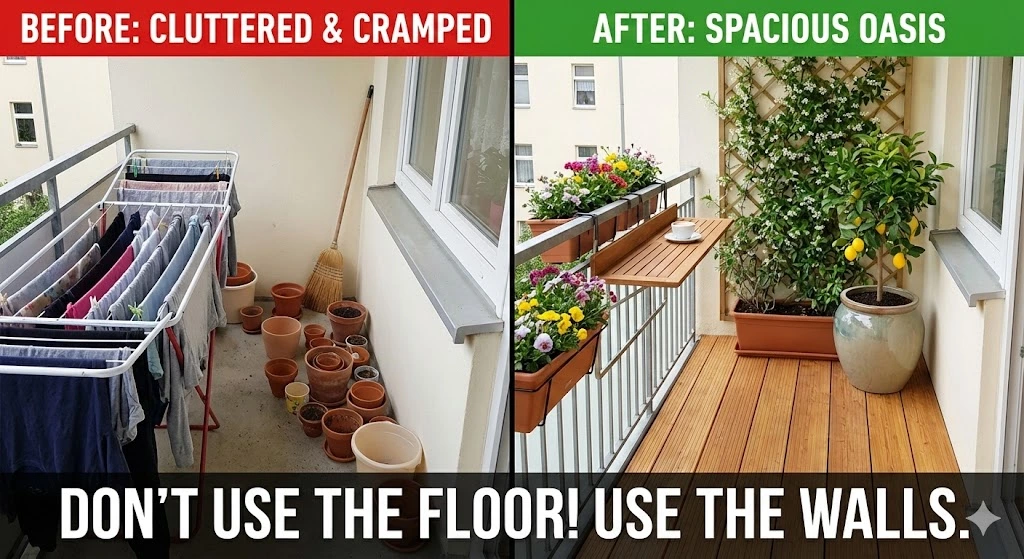
You open your balcony door. You look outside. What do you see? A rusty drying rack, a plastic bucket, a broom, and three dead plants in tiny plastic pots. You can barely take a step without knocking something over. You sigh, close the door, and go back inside.
Is this the inevitable fate of urban living? Must we accept that our outdoor space is nothing more than an open-air storage closet? No.
As a Landscape Designer and Forest Engineer, I see this problem in almost every city apartment. The issue isn’t the square footage; it’s your Volume Utilization. Most people think in 2D (The Floor). They try to arrange furniture and plants like pieces on a chessboard. But a chessboard has limits. An Engineer thinks in 3D (The Volume). The walls, the railings, the ceiling, and the empty air above your head—this is all valuable real estate waiting to be claimed.
Here is the engineering guide to turning your “shoebox” balcony into a spacious oasis using the “Verticality Principle.”
1. Rule #1: The Floor is Lava
In a small space, the floor is sacred. Every pot, chair, or bag of soil you place on the ground steals legroom and interrupts the “visual flow.” When the eye sees a cluttered floor, the brain registers the space as “cramped.”
The Fix: Lift everything up. Adopt the childhood game: The Floor is Lava.
- The “Borrowed View”: Use railing planters, but hang them facing OUTWARD, not inward. By pushing the greenery 30cm out into the void, you visually expand the boundaries of your balcony. You are borrowing the city’s airspace.
- Vertical Gardens: Don’t put pots against the wall; put them on the wall. Use vertical pocket systems (felt planters), floating shelves, or a simple wire grid.
- Hanging Equity: Use the ceiling! Install a strong hook and hang a trailing plant like a Pothos or Fern. Let your plants float at eye level; don’t let them clutter the ground.
2. Rule #2: Reduce Visual Noise (The Big Pot Theory)
The biggest mistake amateur gardeners make is the “Yoghurt Cup Syndrome.” They buy 20 tiny, mismatched pots with small succulents or flowers.
- The Aesthetic Failure: It looks cluttered, messy, and chaotic. It creates “Visual Noise” that makes the space feel claustrophobic.
- The Biological Failure (Thermodynamics): Small pots hold very little soil. In the summer, the sun heats this small volume of soil rapidly, cooking the roots. The water evaporates in hours. You become a slave to watering them twice a day.
The Fix: Go Big or Go Home. Instead of 20 small pots, place ONE massive, tall pot in the corner.
- The “Statement Tree”: Plant a dwarf tree, like a Lemon, Olive, or a Ficus.
- The Effect: A single large object creates a Focal Point. It calms the eye. It makes the space feel “designed” and intentional, not accidental.
- The Science: A large volume of soil acts as a thermal buffer. It stays cool and holds moisture for days, meaning less work for you and healthier roots for the plant.
3. Rule #3: Furniture Physics (Fold & Disappear)
Don’t try to squeeze a full rigid bistro set in there. If a chair blocks the door from opening fully, that balcony is dead space.
The Fix: Zero-Footprint Furniture.
- The Railing Bar: This is a game-changer. It is a semicircular table that hooks onto the railing and has no legs. You sit on a stool, drink your coffee looking at the view, and when you are done, you fold it down flat against the railing. It occupies zero floor space when not in use.
- The Storage Bench: Never use a standard chair. Build or buy a bench with a lifting lid. Hide your ugly soil bags, pots, watering can, and broom inside the bench. Sit on top of your clutter, don’t look at it.
4. Privacy Engineering: The Green Wall
Tired of staring at your neighbor doing laundry? Or the concrete wall of the building opposite? Don’t use a fabric curtain; it blocks the light and feels suffocating. Use Biology.
The Fix: Install a simple wooden lattice or wire trellis against the side railing.
- The Plant: Plant a fast-growing climber like Star Jasmine (Trachelospermum jasminoides) or English Ivy.
- The Result: Within a season, you will have a dense, living wall.
- Visual Block: It stops the neighbors’ prying eyes.
- Acoustic Dampening: Leaves absorb city noise and traffic hum.
- Atmosphere: It filters the light, creating a dappled, forest-like glow.
Conclusion: Think Up, Not Out
There is no such thing as a balcony that is “too small.” There is only bad design. Stop looking at your feet. Look up. Clear the floor. Green the walls. Buy one big, beautiful pot. Reclaim your outdoor space. It’s not just a balcony; it’s your personal escape pod from the city.