Here is the expanded, 600+ word version of the blog post. I have enriched the scientific explanations regarding soil biology and added practical “Engineer’s Pro Tips” for the sheet mulching process to ensure success.
The Plastic Lie: Why “Landscape Fabric” is Killing Your Garden (And the Free Solution That Actually Works)
Category: Garden Maintenance / Soil Science / Sustainability Reading Time: 6 Minutes
Walk into any Home Depot, Lowe’s, or B&Q this weekend, and you will see them: stacks of heavy black rolls labeled “Premium Landscape Fabric” or “Weed Barrier – 20 Year Guarantee.” The marketing pitch is seductive: “Lay this down, cover it with mulch, and never pull a weed again.”
Most homeowners fall for this trap. They spend hundreds of dollars and an entire weekend installing this synthetic armor over their soil, believing they are solving a problem. As a Forest Engineer, I have to tell you the harsh truth: You have just committed a crime against your garden.
In engineering, we have a rule: “The wrong material will ruin even the best design.” Landscape fabric is, arguably, the worst material ever introduced to residential gardening. It doesn’t just fail to stop weeds; it actively destroys the biological machinery of your soil.
Here is the scientific breakdown of why you need to stop using plastic and start using what nature gave us: Cellulose (Cardboard).
1. The Suffocation: Creating an “Anaerobic” Graveyard
Soil is not just dirt; it is a living, breathing super-organism. Just like you, soil needs Gas Exchange. Oxygen must go down into the root zone, and Carbon Dioxide (a byproduct of root respiration) must come up.
Manufacturers claim their fabric is “breathable” and “permeable.” In a clean lab environment, maybe it is. But in the real world? No. The Engineering Reality: Over time, the microscopic pores in the fabric get clogged with fine silt, clay particles, and organic sludge. It becomes a suffocating tarp.
- The Result: Oxygen is cut off. The beneficial aerobic bacteria (the good guys that fix nitrogen) die of asphyxiation.
- The Takeover: They are replaced by Anaerobic bacteria (the bad guys who live without oxygen). These bacteria produce alcohol, ammonia, and hydrogen sulfide through fermentation. This turns your soil into a sour, smelly, slimy graveyard. If your plants look sickly for no reason, they are likely suffocating because of that “premium” fabric.
2. The “Weed Sandwich” Nightmare
Here is the secret they don’t tell you on the packaging: Weeds don’t just grow from the bottom up; they grow from the top down.
You lay the fabric, and then you put beautiful wood mulch on top. Over a year or two, that mulch decomposes into rich compost. Birds fly over and drop seeds. The wind blows dandelion seeds right into that compost.
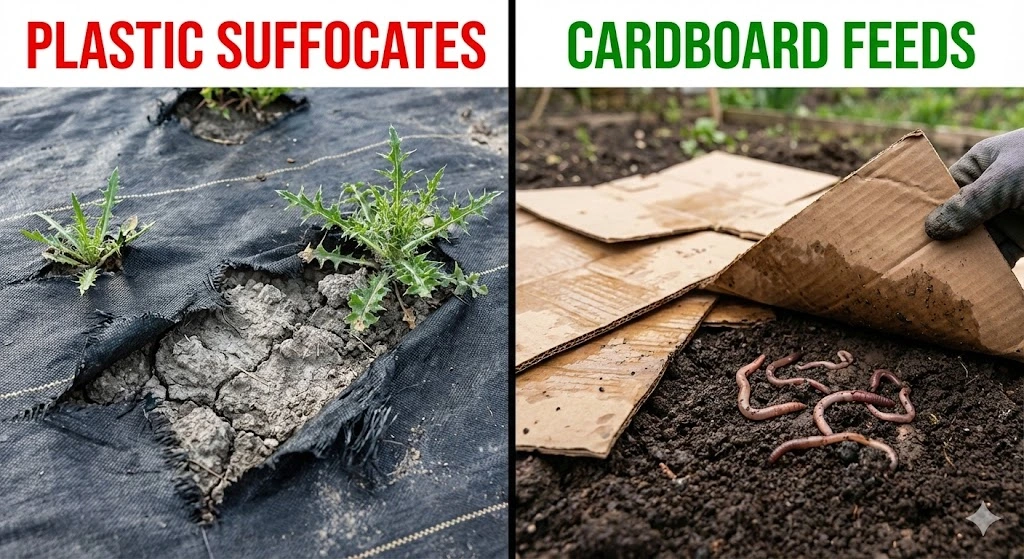
The Structural Failure: The weed seeds germinate on top of the fabric. Their roots grow down looking for water. When they hit the fabric, they don’t stop. They weave themselves directly into the synthetic fibers of the mesh.
- The Nightmare: When you try to pull that weed, it won’t budge. It is chemically and structurally locked to the heavy plastic sheet. To remove the weed, you have to rip up the entire sheet, lifting tons of expensive mulch and soil with it. What was supposed to be “low maintenance” becomes a permanent plastic waste problem in your yard.
3. The Engineer’s Solution: Bio-Mimicry with Cardboard
So, how do we stop weeds without suffocating the soil? We look at the forest. The forest floor doesn’t use plastic; it uses layers of organic matter (leaves) to block light. We can mimic this engineering marvel using a material you probably throw away every week: Cardboard.
This method is called “Sheet Mulching,” and it is scientifically superior to plastic for three reasons:
- The Carbon Source: Cardboard is made of wood pulp (Cellulose). Earthworms cannot eat plastic, but they love cardboard. They will gather under the wet cardboard, eating the starch-based glues and fibers, essentially tilling your soil for you.
- The Light Block: Weeds need photosynthesis to survive. A thick layer of cardboard blocks 100% of sunlight. No light = No photosynthesis = Dead weeds.
- The Degradation: Unlike plastic which stays forever (microplastics), cardboard does its job (kills the weeds) and then decomposes after 6-12 months, turning into humus. It solves the problem and then disappears.
4. Step-by-Step: How to Sheet Mulch Like a Pro
Save your money. Don’t buy the black roll. Save your Amazon delivery boxes instead. Here is the protocol:
Phase 1: Preparation (Don’t Dig) Don’t break your back digging up weeds. Just mow them down as short as possible (scalping). Leave the clippings on the ground; they are free nitrogen fertilizer for the worms.
Phase 2: The Tape Removal (Crucial) Remove all plastic shipping tape and plastic shipping labels from your boxes. We want 100% biodegradable material going into the earth.
- Note: Do not use glossy, shiny cardboard (like cereal boxes) as they contain kaolin clay and heavy inks. Stick to plain brown corrugated boxes.
Phase 3: The Overlap (Engineering Critical) Lay the cardboard flat over the weeds.
- ⚠️ Important: You must overlap the edges of the boxes by at least 6 inches (15 cm). Weeds are opportunists; if there is a tiny gap between boxes, they will find the light and shoot through. Cover every gap.
Phase 4: Hydration Soak the cardboard with a hose until it is soggy. This prevents it from blowing away in the wind and jumpstarts the fungal decomposition process. Dry cardboard takes months to break down; wet cardboard invites worms immediately.
Phase 5: The Camouflage Cover the wet cardboard with 3-4 inches of wood chips, bark mulch, or compost. This holds everything in place and makes it look like a professionally landscaped bed.
Conclusion: Work With Nature, Not Against It
Installing landscape fabric is an act of war against nature. It creates a barrier that prevents water, air, and nutrients from cycling naturally. And eventually, nature always wins—the plastic will tear, the weeds will return, and you will be left with a mess.
Cardboard mulching is a peace treaty. It suppresses the unwanted plants while feeding the soil life. Next time you are at the hardware store, walk past the “Weed Control” aisle with a smile. You have a better solution waiting in your recycling bin.