
It is a classic Saturday morning scenario. You decide it is finally time to remove that low-hanging branch on the walnut tree. You head to the garage, rummage through the toolbox, and pull out the old hand saw you used to cut 2x4s for the deck project three years ago.
You think: “Wood is wood, right? A saw is a saw.”
As a Forest Engineer, I am here to tell you: You are wrong.
Using a carpenter’s saw on a living tree is not pruning; it is butchery. It is the biological equivalent of a surgeon using a serrated steak knife to perform an appendectomy.
The difference between a “cut” and a “tear” might look small to you, but to the microscopic anatomy of a tree, it is the difference between life and death. Today, we are going to look inside the branch—at the Xylem and Phloem—to understand why you need a specialized pruning saw.
1. The Anatomy of a Pipe System: Understanding Xylem and Phloem
To understand why the tool matters, you first need to understand what you are cutting. A tree branch is not a solid block of dead material like a piece of lumber. It is a bundle of thousands of microscopic, living straws.
These “straws” form two critical pipeline systems:
A. Xylem ( The Water Elevator)
Located deeper inside the wood (sapwood), the Xylem is responsible for transporting water and dissolved minerals from the roots up to the leaves. Think of these as rigid, high-pressure pipes.
B. Phloem (The Food Highway)
Located just under the bark, the Phloem transports the sugars (energy) created by photosynthesis from the leaves down to the roots. These are softer, more fragile tubes.
The Cambium Layer: Sandwiched between them is the Cambium, a microscopic layer of stem cells that produces new wood. This is the tree’s “healing center.”
When you prune a branch, you are severing these pipelines. The goal of a proper cut is to slice these tubes cleanly so they can seal off. If you crush or tear them, you destroy the tree’s ability to compartmentalize the wound.
2. The Carpenter’s Saw: The Blunt Instrument
A standard carpenter’s saw is designed for dead, dry lumber.
- The Teeth: The teeth are set wide (the “kerf”) to clear sawdust out of dry wood. They act like tiny chisels that “rip” the wood fibers apart.
- The Action: They usually cut on the “push” stroke, which requires force.
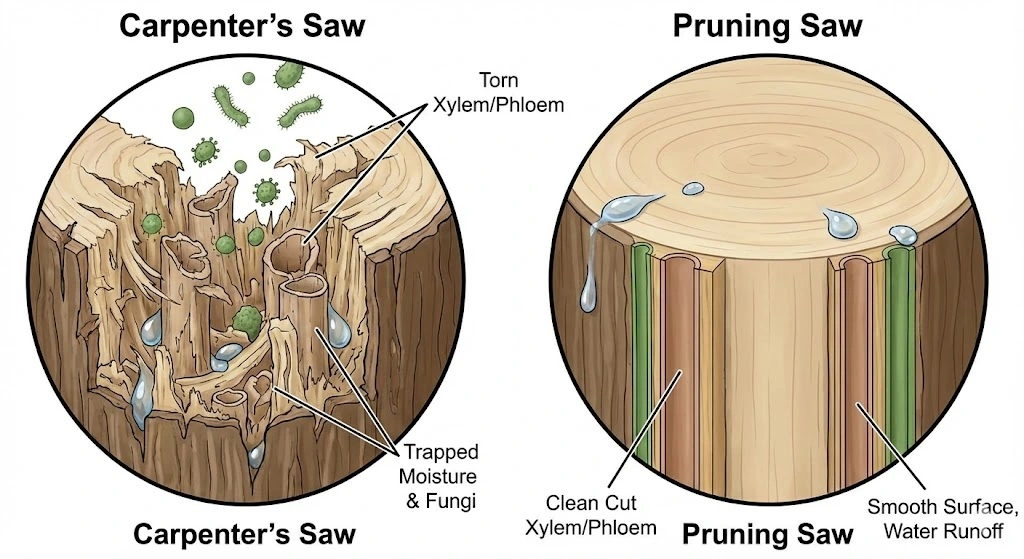
When you take this tool to a living, green branch, it doesn’t slice; it shreds. The wide teeth catch on the soft, wet fibers. Instead of cutting the Xylem and Phloem cleanly, it pulls them out, leaving a ragged, fuzzy surface. You might not see it from a distance, but under a microscope, that cut looks like a bomb went off.
3. The Biology of the Wound: Why “Smooth” Means “Safe”
This is the core of the engineering problem. Why does surface smoothness matter?
The “Surface Area” Danger
A ragged cut created by a carpenter’s saw has thousands of microscopic peaks and valleys. This drastically increases the surface area of the wound.
- Water Trap: Those ragged fibers act like a sponge, holding onto rainwater and dew.
- Fungal Hotel: Fungi and bacteria need moisture to colonize. A rough, wet cut is the perfect breeding ground for pathogens.
The “Callus” Failure
Trees heal by growing a “callus” (wound wood) from the edges inward, eventually covering the cut (The “Donut” shape). If the Phloem and Cambium are torn or separated from the bark (which happens constantly with dull carpenter saws), the tree cannot start this bridging process. The signal is interrupted. The wound stays open, and rot begins to travel down the branch collar into the main trunk.
The Pruning Saw Advantage: A specialized pruning saw leaves a surface as smooth as sanded furniture.
- Water runs off immediately.
- There are no hiding spots for spores.
- The Cambium is perfectly intact, allowing the callus to roll over the wound rapidly.
4. The Geometry of the Blade: Tri-Edge and Pull-Stroke
So, what makes a pruning saw different? It comes down to physics.
1. Tri-Edge Teeth (Razor Technology): Look closely at a quality pruning saw (like a Silky or Felco). The teeth are not simple triangles. They are ground on three different angles (Tri-edge). They act like knives, shaving the wood cells rather than ripping them. They are designed specifically for “green” (wet) wood.
2. The Pull Stroke: Most professional pruning saws cut on the pull stroke.
- Physics: When you push a saw, the thin blade can bend or buckle. When you pull, the steel naturally straightens.
- Control: This allows for a much thinner blade, which means less friction and a surgical level of precision. You don’t need to force it; you just guide it.
Conclusion: Invest in the Surgery
If you care about the longevity of your trees, put the rusty garage saw away. It belongs on 2x4s, not on your cherry tree.
Buying a dedicated pruning saw is not an unnecessary expense; it is cheaper than hiring an arborist to remove a rotted tree five years from now. Remember: You are not just cutting wood; you are performing surgery on a living vascular system.
Treat your trees like patients, not like lumber.