
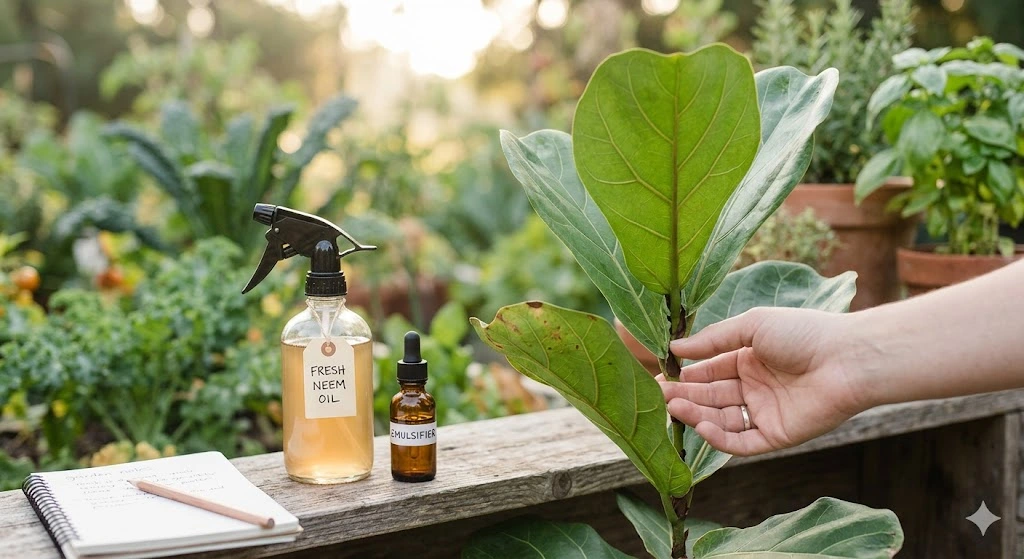
If you are committed to organic gardening, you’ve likely reached for Neem oil as your first line of defense. It is the “holy grail” of natural pesticides—effective against everything from aphids to powdery mildew. But here is the frustrating reality: many gardeners spray their plants to save them, only to wake up forty-eight hours later to find their prized specimens covered in brown, crispy, or yellowing patches.
When I transitioned to a chemical-free forest garden, I assumed “natural” meant “safe under any condition.” I was wrong. Neem oil is a powerful botanical tool, but if used incorrectly, it becomes a herbicide rather than an insecticide.
The good news? The oil itself isn’t the problem; it’s the application. Here is exactly why you are burning your plants’ leaves and how to use Neem oil like a professional.
1. The “Magnifying Glass” Effect (Timing is Everything)
This is the number one reason for leaf burn. Neem oil is an oil. When you coat a leaf in a thin layer of oil and then expose it to direct, midday sun, you are essentially creating a magnifying glass on the plant’s surface.
This causes phototoxicity. The sun’s rays are concentrated by the oil, literally cooking the plant tissue underneath. Even if the temperature is mild, the intensity of the UV rays combined with the oil film is a recipe for disaster.
The Fix: Only spray Neem oil in the late evening or very early morning. This gives the oil time to dry and the volatile components to dissipate before the sun hits the foliage.
2. Failure to Emulsify: The “Oil and Water” Trap
Neem oil and water do not mix. If you simply pour Neem oil into a spray bottle with water and start pumping, you are going to spray pure water for the first half of the bottle and pure, concentrated oil for the second half. That concentrated blast of oil is far too strong for most plant cuticles and will cause immediate chemical burns.
The Fix: You must use an emulsifier. Add a few drops of mild, tea-tree-free liquid soap (like Castile soap) to your warm water before adding the Neem oil. Shake vigorously. The soap breaks the surface tension, allowing the oil to stay suspended in the water for an even, safe application.
3. Using “Stale” Mixtures
Many gardeners mix up a large batch of Neem spray, use half, and save the rest for next week. Stop doing this. Once Neem oil is mixed with water, the active compound (Azadirachtin) begins to break down. Not only does it lose its insecticidal properties within 24 hours, but the decaying mixture can become more acidic and unstable, increasing the risk of foliage damage.
The Fix: Only mix what you can use in one sitting. If you have leftovers, find a sacrificial weed or a hardy shrub to spray it on, but never store a diluted mixture for later use.
4. Over-Applying on Sensitive Species
In a forest garden, biodiversity is key, but not every plant reacts the same to oil. Some plants have “fuzzy” leaves (like borage or certain herbs) or very thin, delicate cuticles (like Japanese Maples) that trap the oil and suffocate. If the oil cannot evaporate or wash off, the leaf tissue begins to rot or burn from the inside out.
The Fix: Always perform a patch test. Spray a single leaf and wait 48 hours. If the leaf remains green and healthy, proceed with the rest of the plant. Avoid spraying drought-stressed plants or those in the middle of a heatwave.
5. Ignoring the “Rinse” Cycle
Neem oil is meant to disrupt the life cycle of pests, but it shouldn’t live on your leaves forever. A heavy buildup of oil over several weeks can clog the stomata (the pores through which plants breathe). A suffocating plant is a stressed plant, and a stressed plant is more likely to show “burn” symptoms even from mild sun exposure.
The Fix: If you are using Neem oil as a preventative, give your plants a “spa day” every two weeks. Use a hose to gently wash the residue off the leaves. This clears the pores and keeps the foliage performing at its peak.
The Bottom Line
Neem oil is a gift to the organic gardener, but it must be respected as a potent chemical—even if it is a natural one. By emulsifying correctly, timing your sprays for the evening, and always testing a single leaf first, you can keep your forest garden pest-free without the heartbreak of scorched foliage.
Have you experienced the dreaded Neem burn in your garden? Which plant in your collection seems the most sensitive to oils? Let me know in the comments below!






Nice