
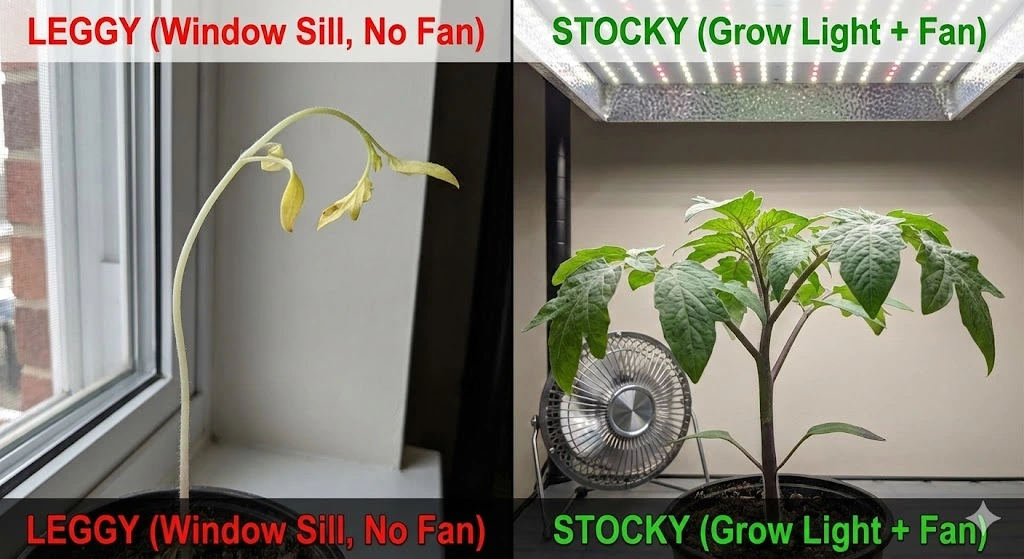
You planted your tomato seeds. You watered them. You placed them proudly on your sunniest windowsill. A week Here is the expanded, 600+ word version of the blog post. I have added a section on Temperature Control (DIF)—a professional greenhouse technique—and a “Rescue Mission” guide for seedlings that are already leggy, to make this a complete resource.
Stop Growing “Noodles”! Why Your Seedlings are Leggy and How to Engineer Strong Plants
Category: Seed Starting / Plant Physiology Reading Time: 6 Minutes
It happens every spring. You plant your tomato or pepper seeds in little pots. You water them lovingly. You place them on your sunniest windowsill. A week later, you celebrate as the little green shoots pop up. But two weeks later? Disaster.
Instead of strong, stocky, “bodybuilder” plants, you have pale, thin, stringy beanstalks. They stretch desperately toward the glass, flopping over under their own weight. Eventually, the stem snaps or rots, and they die.
We call these “Leggy Seedlings.” The scientific name is Etiolation. Most gardeners think this happens because of “too much water,” “bad soil,” or “weak seeds.” As a Forest Engineer, let me tell you the truth: Your plants are starving, and your window is lying to them.
Let’s break down the biology of why this happens and the engineering hacks to stop the stretch and start the bulk.
1. The Culprit: Auxins and the “Shadow Panic”
To fix the problem, you must understand the mechanism. Plants have growth hormones called Auxins. These hormones control the elongation of cells. Here is the engineering secret: Auxins are photophobic. They hate light. They actively migrate to the darkest side of the stem.
- In Full Sun: The intense light destroys or pushes the Auxins down to the roots. This keeps the stem short, thick, and sturdy.
- On a Window Sill: The light is weak and directional (coming from only one side). The Auxins accumulate on the “shaded side” of the stem. This causes the cells on the dark side to elongate rapidly, while the cells on the bright side stay short.
- The Result: The plant bends toward the light. It is essentially panicking: “I can’t find the sun! I need to grow TALLER right now or I will die!” It sacrifices stem thickness (girth) for height. The result is a weak structure that collapses because it built a skyscraper without a foundation.
2. The Window Filter Effect (The Lie)
“But my window faces South! It’s very bright!” To a human eye, yes. To a plant, no. Our eyes are amazing cameras that adjust to low light. A plant’s photosynthesis does not adjust; it relies on raw photons.
The Physics: Modern double-paned glass filters out UV rays and significantly reduces the PAR (Photosynthetically Active Radiation). Furthermore, light follows the Inverse Square Law. A plant touching the glass gets “X” amount of energy. A plant just 1 foot away from the window gets 1/4 of that energy. A plant 2 feet away gets 1/16. To a seedling, the inside of your house is a cave. It will stretch until it finds the exit.
3. Engineering Fix #1: Artificial Sun (The 2-Inch Rule)
If you want strong seedlings, you usually need a Grow Light (LED or Fluorescent). But owning the light isn’t enough; you have to position it correctly.
- The Mistake: Hanging the light 2 feet above the tray to “cover more area.” This dilutes the light intensity too much.
- The Engineer’s Rule: The light needs to be 2 to 3 inches (5-7 cm) away from the top of the seedlings. Yes, that close.
- Why? This intense, direct light destroys the Auxins in the stem tips. It tells the plant: “We found the sun! Stop stretching and start building muscle.” As the plants grow, you raise the light.
4. Engineering Fix #2: The Gym for Plants (Thigmomorphogenesis)
In nature, wind blows. It shakes the young plant back and forth. The plant senses this mechanical stress and responds by reinforcing its cell walls with Lignin (wood) and thickening its stem. This biological process is called Thigmomorphogenesis.
Inside your house, the air is dead still. Your seedlings are lazy because they don’t need to be strong to stand up… until they get too heavy and snap.
- The Hack: Get a small computer fan or a gentle desk fan. Point it at your seedlings. Turn it on for 2-3 hours a day.
- The Workout: The gentle breeze will vibrate the stems. This “workout” tricks the plant into thinking it lives in a windy environment, forcing it to grow a thick, sturdy trunk instead of a noodle-like stem.
5. Engineering Fix #3: Temperature Control (The DIF Technique)
Here is a pro tip used in commercial greenhouses. Plants stretch the most when it is warm and dark (i.e., inside your house at night). If you keep your house at 72°F (22°C) day and night, the seedlings will stretch while you sleep.
- The Fix: Lower the temperature at night to 60°F-65°F (15°C-18°C) if possible. The difference between day and night temperatures (DIF) helps regulate stem elongation. Cool nights = Short, stocky plants.
Conclusion: Tough Love
Don’t baby your seedlings. A warm, dark, still room is a death sentence. To grow a garden that survives the transition to the outdoors, you need to be an engineer:
- High Light Intensity (Keep lights 2 inches away).
- Mechanical Stress (Use a fan to simulate wind).
- Cooler Nights (Reduce the stretch).
Stop the stretch. Start the workout.