You bought a beautiful, expensive sapling from the nursery. You drove it home, excited to add shade and beauty to your property. You dug a hole. You threw the tree in. You filled it back up. Congratulations! You likely just sentenced that tree to a slow, suffocating death.
As a Forest Engineer, I see this tragedy in almost every suburban backyard. Trees rarely die immediately after planting. They die a “slow motion death” over 3 to 5 years. They don’t die from pests or drought; they die from “Planting Errors” that slowly strangle their vascular system or rot their trunks.
Planting a tree is not just “digging a hole.” It is a surgical operation. It requires precision, biology, and an understanding of soil physics. Here are the 3 Engineering Rules you must follow to ensure your tree survives for decades, not just seasons.
1. Rule #1: Perform Surgery on the Roots (Box Cutting)
When you pull a tree out of a plastic nursery pot, look at the roots. You will often see a dense mat of white roots circling around the edge of the pot, spiraling like a coiled spring. This is called being “Pot-Bound” (or Root-Bound).
The Myth: Most homeowners think they should be gentle. They carefully place this delicate root ball into the ground, terrified of breaking a single root. The Engineering Truth: You must be aggressive. If you plant the tree like this, those circling roots will never spread out. They will continue to circle, growing thicker and tighter over time. Eventually, they will wrap around the tree’s own trunk and choke it to death. We call these “Girdling Roots.”
The Protocol: “Box Cutting” You need to break the memory of the pot.
- Shave the Edges: Take a sharp serrated knife, a saw, or a sharp spade. Shave off the outer 1-inch of the entire root ball on all four sides. Yes, you are cutting roots. This is good.
- Cut the Bottom: Slice off the bottom inch of the root mat. This removes the “J-roots” that are growing upwards.
- Tease Them Out: Don’t be afraid to loosen the remaining root ball with your hands.
- The Result: Every cut you make stimulates the tree to push out new, straight roots into the native soil, anchoring the tree firmly.
2. Rule #2: Expose the “Root Flare” (No Telephone Poles!)
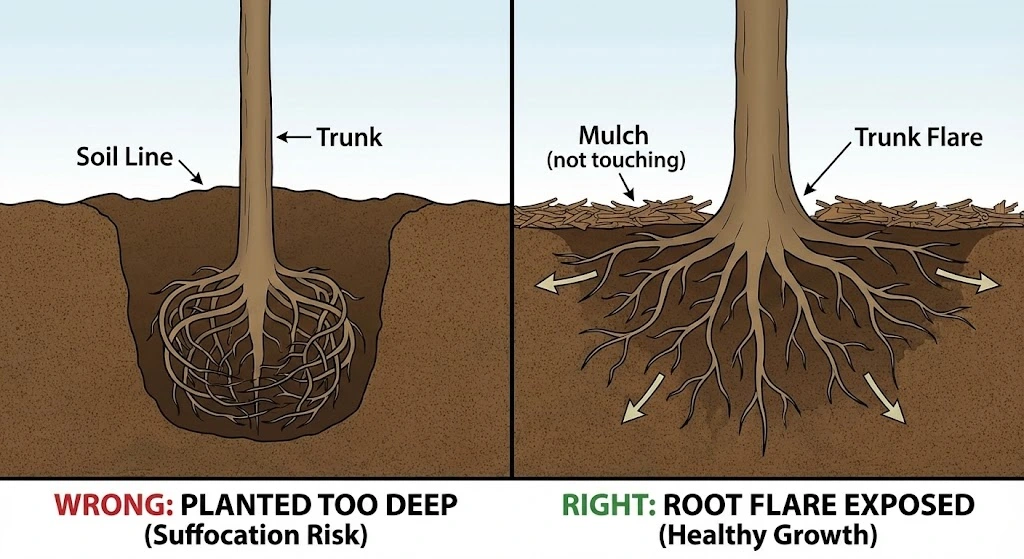
This is the #1 killer of modern trees: Planting Too Deep. Walk around your neighborhood. Look at the trees. Do the trunks go straight into the ground like a telephone pole? If so, those trees are suffocating.
The Biology: A tree trunk should not look like a pole; it should look like a wine glass. It should have a visible widening at the base where the roots begin to spread. This is called the Root Flare (or Root Collar).
- Why it matters: The bark on the root flare is specialized. It is designed to breathe oxygen. If you bury this flare under 3 inches of soil or heavy mulch, the bark stays wet and cannot exchange gases. It slowly rots. This invites pathogens and insect borers into the main trunk.
The Protocol:
- Find the Flare: Before you even dig the hole, remove the excess soil from the top of the nursery pot. Nurseries often bury trees too deep in the pot itself! Dig down until you find the first main structural roots spreading out.
- Measure Twice: The hole should be no deeper than the distance from the Root Flare to the bottom of the root ball.
- Plant High: It is better to plant the tree 1-2 inches higher than the surrounding ground level. The tree will settle over time. If you plant it low, it will drown.
3. Rule #3: Don’t Create a “Bathtub”
You dug a hole in heavy clay soil. You bought a bag of expensive, fluffy “Tree Planting Mix” or peat moss. You filled the hole with this perfect soil. You think you are being kind. You just built a swimming pool.
The Physics: Water moves differently through different soil textures. This is called the “Soil Interface” problem. When it rains, water flows easily through your fluffy potting soil. But when it hits the hard, clay walls of the hole you dug, it stops. It drains very slowly.
- The Result: The hole fills up with water like a bathtub. Your tree ends up sitting in a bowl of stagnant water for days. The roots rot from lack of oxygen (Hypoxia). Furthermore, the roots love the fluffy soil so much that they refuse to leave it. They stay in the hole, circling round and round, never anchoring into the real earth.
The Protocol: Refill the hole with the Native Soil you dug out. Break up the clods, remove the big rocks, but put the dirt back in. You can mix in a little compost (max 20%), but the tree needs to learn to live in your garden’s actual soil ecosystem immediately.
Conclusion: Do It Right the First Time
Trees are not annual flowers. They are long-term infrastructure. Don’t rush the planting.
- Cut the circling roots.
- Find the flare.
- Use the native soil.
If you follow these three engineering rules, your tree won’t just survive; it will thrive for the next 50 years.