Here is the expanded, 600+ word version of the blog post. I have deepened the technical explanations (Material Science) and added practical “Engineer’s Tests” to help the reader identify quality in the showroom.
The “War Zone” in Your Backyard: An Engineer’s Guide to Buying Garden Furniture That Actually Lasts
Category: Outdoor Living / Material Science Reading Time: 6 Minutes
Buying garden furniture is an investment. But too often, I see homeowners spending thousands of dollars on patio sets that look stunning in the showroom, only to crack, fade, or rot after a single winter.
Here is the harsh reality: The outdoors is a war zone for materials. From the moment you place that chair on your patio, it is under attack. UV radiation is trying to break down its chemical bonds. Moisture cycles (rain and humidity) are trying to swell and rot it. Fungal spores are looking for a home. Temperature fluctuations are expanding and contracting the joints.
As a Forest Engineer, I don’t look at furniture like an interior designer. I don’t care about the cute cushion patterns or the “trendiness” of the weave. I care about density, tensile strength, and decay resistance.
Before you swipe your credit card, read this guide on which materials actually survive the war against nature.
1. Wood: The Density Matter (Teak vs. The Rest)
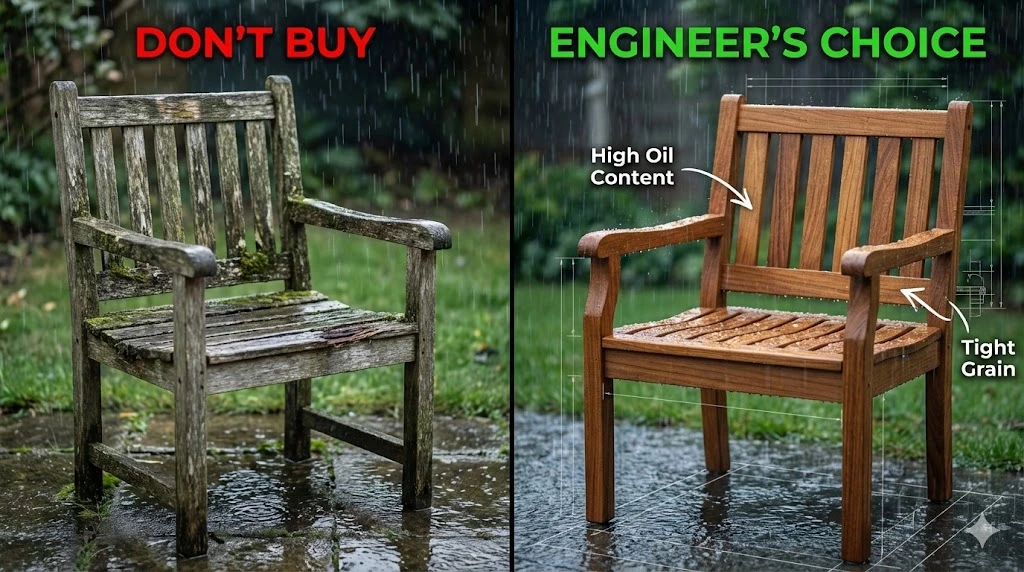
Not all wood is created equal. Many cheap furniture sets are made from softwoods (like Pine or low-grade Cedar) that have been stained to look expensive.
- The Problem: Softwoods are porous. Their cellular structure absorbs water like a sponge. When that water freezes in winter, it expands, causing the wood to crack from the inside out. Furthermore, the high sugar content in the sapwood invites fungi and insects to feast.
- The Engineer’s Choice: Go for Teak or Iroko.
- Teak (Tectona grandis): This is the gold standard. It has a Class 1 Durability rating. Teak is saturated with natural rubber and oils that actively repel water and insects, even if you leave it outside in the rain for 20 years. It doesn’t need varnish; it simply weathers to a beautiful, dignified silvery-grey patina.
- Iroko: Often called “African Teak,” this is the smart budget choice. It offers 80% of the durability of Teak at 50% of the price.
⚠️ The “Acacia” Warning: Be very careful with furniture labeled simply as “Hardwood” or “Acacia.” While Acacia is harder than Pine, it is extremely sensitive to humidity changes. Unless you oil it 3 times a year, it will warp and crack.
2. The “Wicker” Trap: PVC vs. HDPE
Synthetic wicker (rattan) is aesthetically pleasing, but there is a hidden trap here. There are two main types of plastic used, and they look identical to the naked eye in the store.
- The Trap: PVC (Polyvinyl Chloride). This is the cheap stuff. PVC is chemically unstable under UV radiation. After two summers, the sun’s rays will make it brittle. It will crack, unravel, and snap when you sit on it.
- The Solution: HDPE (High-Density Polyethylene). This is what you want. It is a thermoplastic with high tensile strength that is extremely resistant to UV rays and temperature shocks. It doesn’t fade or crack.
🔍 How to Tell the Difference in the Store:
- The Touch Test: Does it feel like smooth, hard, shiny plastic? That’s likely PVC. HDPE feels slightly waxy, textured, and “organic.”
- The Scratch Test: Try to scratch the material with your fingernail. HDPE is solid color all the way through; PVC might show a different color underneath.
3. Metal: Steel vs. Aluminum (The Rust Equation)
Metal furniture looks modern and sleek, but oxidation (rust) is the enemy.
- Steel (The Rust Magnet): Steel is heavy and sturdy, which is good for wind. However, unless it is galvanized and perfectly powder-coated, it will rust. Once a tiny scratch exposes the iron to air, oxidation begins. The rust expands under the paint, lifting it off in bubbles.
- Aluminum (The Engineer’s Favorite): Aluminum cannot rust. When aluminum oxidizes, it forms a microscopic, chalky layer (Aluminum Oxide) that actually seals and protects the metal underneath. It is self-healing.
- The Downside: Tubular aluminum is lightweight and can blow away in a storm.
- The Fix: Look for Cast Aluminum. It is heavy like iron but rust-proof like aluminum. If you live near the coast (salt spray), Cast Aluminum is the only logical choice.
4. Fabric: The “Carrot vs. Radish” Analogy
The frame might last 20 years, but what about the cushions? Standard polyester fabrics are usually “piece-dyed,” meaning the color is just sprayed on the surface of the thread. The sun will bleach this out in months.
The Solution: Look for “Solution-Dyed Acrylic” (brands like Sunbrella or Olefin).
The Science of Color:
- Cheap Fabric (The Radish): Red on the outside, white on the inside. When the sun burns off the outer layer (Photodegradation), the color fades to white.
- Quality Fabric (The Carrot): Orange on the outside, orange on the inside. In solution-dyeing, the color pigment is mixed into the liquid plastic before it is spun into thread. The color goes all the way through the fiber. You could cut it with a knife, and it would still be the same color inside.
Conclusion: Buy Nice or Buy Twice
In engineering, we have a saying: “The most expensive tool is the one you have to replace.” The same applies to your garden. A cheap $300 pine set that rots in two years is infinitely more expensive than an $800 Teak set that lasts for twenty.
Next time you are in the showroom, ignore the colors and the “50% Off” signs. Touch the material. Ask about the plastic type. Check the wood species. Invest in durability, and nature will treat you well.