Here is the expanded, 600+ word version of the blog post. I have added a specific section on the dangers of using Iron Sulphate (it actually makes the problem worse long-term) and fleshed out the diagnostic tests for each problem to make it a complete engineering guide.
Stop Using Moss Killer! Why Moss is Not the Enemy, But a Symptom of Soil Failure (An Engineer’s Guide)
Category: Lawn Care / Soil Science Reading Time: 5 Minutes
Spring has arrived. The snow melts, the days get longer, and you step out to inspect your lawn. Instead of the lush, emerald green carpet you dreamed of all winter, you see patches of velvety, deep green moss taking over. It feels soft underfoot, almost spongy.
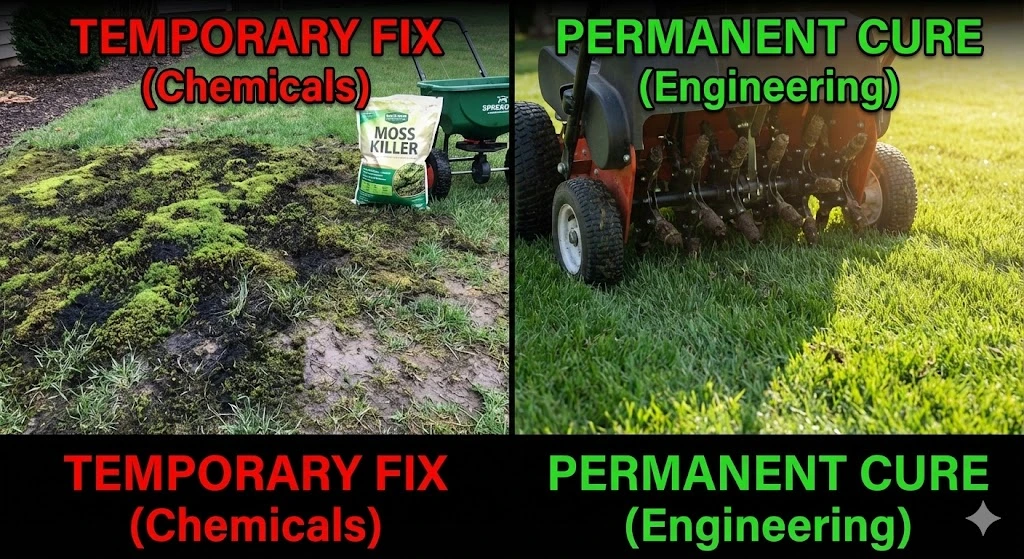
Your first instinct is probably to run to the hardware store, buy a big bag of “Moss Killer” (Ferrous Sulphate), and spread the black dust everywhere. Congratulations, you just painted the moss black for a few weeks. But you wasted your money. And worse, you likely made the soil condition even better for moss to return in the autumn.
As a Forest Engineer, let me tell you the hard truth: Moss is not an invader; it is an opportunist. Biologically, moss is a primitive plant. It doesn’t have true roots; it has tiny filaments called rhizoids that anchor it to the surface. It cannot outcompete healthy, vigorous grass. It only fills the ecological void where grass has already failed.
If you have moss, you don’t have a “weed problem”; you have a “Geo-Engineering Problem.” Moss is a “Bio-Indicator.” It is screaming at you that your soil is failing in one of these 4 specific ways.
1. The Failure: Soil Compaction (Suffocation)
Roots need two things to survive: Water and Oxygen. In soil science, we talk about “pore space”—the empty gaps between soil particles. If your lawn has heavy foot traffic, kids playing football, or dogs running on it for years, the soil particles get pressed together like concrete. The pore space collapses.
- The Mechanism: Grass roots cannot penetrate this hardpan, and they suffocate from lack of oxygen. The grass dies back, leaving bare dirt.
- The Opportunity: Moss, having no roots, loves this hard surface. It sits right on top, thriving where the grass died.
- The Engineering Fix: Aeration. Stop spraying chemicals. Rent a “Core Aerator” machine. It pulls 3-inch plugs of soil out of the ground, physically creating new pore spaces. This allows oxygen to rush back into the root zone, allowing the grass to breathe again.
2. The Failure: Poor Drainage (The Swamp Effect)
Moss is essentially an aquatic plant that adapted to land. It can practically swim. Turf grass, on the other hand, hates having “wet feet.”
- The Mechanism: If water pools on your lawn in the winter, or the soil remains soggy for days after a rainstorm, the grass roots will rot (root asphyxiation).
- The Opportunity: While your grass is rotting, the moss is drinking. It thrives in these swampy, anaerobic conditions.
- The Engineering Fix: You must fix the hydrology. Check the slope of your yard—is water trapped? You may need to install French Drains to move the water away. For heavy clay soils, “Topdressing” with coarse sand after aeration can improve permeability over time.
3. The Failure: Deep Shade (The Solar Deficit)
Photosynthesis 101: Grass is a high-energy plant. It needs sun to produce sugar. Most turf grasses (like Bermuda or Ryegrass) need at least 4-6 hours of direct sunlight daily.
- The Mechanism: If your trees have grown larger over the years, they are casting deeper shade. The grass thins out because it is literally starving for light.
- The Opportunity: Moss has a very low photosynthetic threshold. It can survive in deep shade where grass dies.
- The Engineering Fix: You have two choices.
- Crown Lifting: Prune the lower branches of your trees to let more light reach the ground.
- Surrender: If the shade is too dense, stop fighting nature. Replace the grass with shade-tolerant groundcovers like Hostas, Ferns, or Pachysandra.
4. The Failure: Acidic Soil (The Chemical Trap)
This is the most common hidden cause. Grass prefers neutral to slightly acidic soil (pH 6.5 – 7.0). Moss thrives in highly acidic soil (pH below 6.0).
- The Mechanism: When soil becomes too acidic, nutrients like Magnesium and Calcium become chemically locked up. The grass cannot eat, so it weakens.
- The Trap of “Moss Killer”: Most commercial moss killers are Iron Sulphate. Iron is acidic. While it burns the moss today, it lowers your soil pH even further tomorrow. You are creating the perfect environment for more moss next year!
- The Engineering Fix: Get a simple Soil pH Test Kit. If it reads below 6.0, apply Garden Lime (Calcium Carbonate). Lime “sweetens” the soil, raising the pH back to neutral. This makes the soil hospitable for grass and hostile for moss.
Conclusion: Treat the Disease, Not the Symptom
Using moss killer is like putting a bandage on a broken leg. It hides the issue (by turning it black), but it doesn’t fix the bone. Walk into your garden today and look at it like an engineer:
- Is it hard as rock? (Compaction)
- Is it wet and squishy? (Drainage)
- Is it dark? (Shade)
- Is it sour? (Acidity)
Fix the fundamental soil physics, and the grass will become so strong that it will naturally choke out the moss without a single drop of poison.so healthy it will choke out the moss naturally.