You grab your Sunday coffee, step out onto the patio, and look at your lawn. It looks tired. It’s patchy, yellowish, and just… sad. Then, you look over the fence at your neighbor’s yard. It is emerald green, lush, and looks like a deep pile carpet.
You probably think, “He must be using very expensive fertilizer,” or “He spends all day watering it.” As a Forest Engineer, let me tell you the truth: You are likely wrong. Your neighbor’s secret isn’t about how much money he spends; it’s about how well he understands biology.
A lawn is essentially a miniature forest made up of millions of tiny plants. And unfortunately, most homeowners are killing this forest with “too much love” (wrong watering) and “bad haircuts” (scalping). Let’s put aside the myths. Here is the scientific formula for that “Deep Green” look that will make your neighbors jealous.
1. The “Solar Panel” Rule: Stop Scalping Your Lawn
There is a common obsession in American suburbs: “I’ll cut the grass as short as possible so it looks like a putting green, and I won’t have to mow it next week.” This is called Scalping, and it is the #1 mistake you can make.
The Engineering Truth: Remember high school biology? Photosynthesis. Plants produce energy (sugar) through their leaves using sunlight. Those green blades of grass are actually biological solar panels. When you cut the grass too short (below 2 inches), you destroy the plant’s ability to create food. Starving, the plant uses up the energy stored in its roots to survive.
- The Result: The roots shrink (root dieback), the soil gets hot and dry, and weeds take over because sunlight hits the dirt directly.
🌲 Engineer’s Pro Tip: Raise your mower deck to the highest setting (3.5 to 4 inches). Taller grass means more solar panel surface area. More solar panels mean more energy for deep roots. Plus, tall grass shades the soil, preventing weed seeds (like Crabgrass) from germinating.
2. Training the Roots: The “Lazy Root” Syndrome
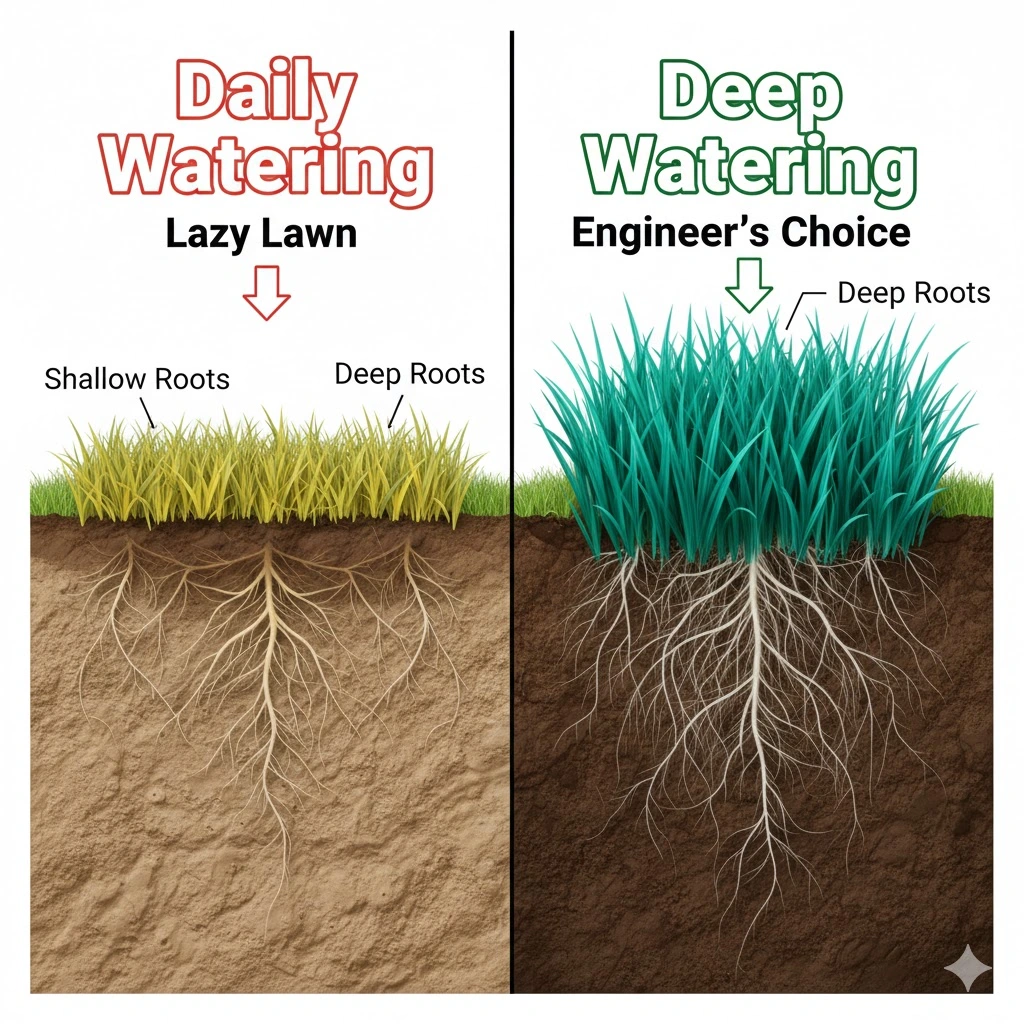
Do you water your lawn for 15 minutes every evening? If so, you are training your grass to be lazy.
The Engineering Truth: Roots have a property called Hydrotropism—they grow toward moisture. If you water lightly every day, the water only penetrates the top inch of soil. The roots say, “The water is right here, why should I grow down?” and they stay at the surface.
- The Result: Surface roots are weak. When the scorching July heat hits, the topsoil dries out in hours. Your shallow-rooted grass has no backup water source and turns yellow immediately (Dormancy).
🌲 Engineer’s Pro Tip: Water only once or twice a week, but water deeply. Put down enough water to penetrate at least 6 inches deep into the soil. This forces the roots to dive downward to find moisture in the cool, deep soil. Deep roots = Green grass.
3. The Hidden Chemistry: pH Balance and “Nutrient Lockout”
So, you went to the store, bought the most expensive bag of Nitrogen fertilizer, and dumped it on your lawn. But it’s still yellow? You just threw your money away.
The Engineering Truth: Soil pH determines the plant’s ability to “eat.” Grass generally loves a pH between 6.0 and 7.0 (Neutral). If your soil is too acidic (below 5.5), chemical bonds form between the soil particles and the nutrients. We call this “Nutrient Lockout.” Imagine sitting at a buffet table full of food, but your mouth is taped shut. That is your lawn. Your grass roots are swimming in food, but they are chemically unable to absorb it. They starve to death on a full stomach.
🌲 Engineer’s Pro Tip: Before buying another bag of fertilizer, buy a $15 Soil pH Test Kit. If your pH is low, apply Lime to fix the chemistry first. Without the right pH, fertilizer is useless.
4. Are Your Blades Razor Sharp?
Walk out to your lawn right now and look closely at a single blade of grass. Is the tip cut cleanly, or is it shredded, white, and frayed?
The Engineering Truth: A dull mower blade doesn’t cut the grass; it tears it. These jagged, torn tips turn brown and white within 24 hours as the cells die. When you look at your lawn from a distance, these millions of brown tips create a “Grey/Brown Haze” over the entire yard. Furthermore, these open wounds make your grass highly susceptible to fungal diseases like Leaf Spot.
🌲 Engineer’s Pro Tip: Sharpen or replace your mower blades at least twice a season. A clean cut heals in hours, sealing the moisture inside the plant.
5. The Secret Ingredient: Iron (Fe)
Is your neighbor’s lawn not just green, but a deep, dark “Blue-Green”? And does it seem like he isn’t mowing it every 3 days?
The Engineering Truth: Most commercial fertilizers are packed with Nitrogen (N). Nitrogen triggers explosive growth (vertical growth), forcing you to mow constantly, but it doesn’t always give that deep color. The secret to the dark color is Iron (Fe). Iron is essential for the synthesis of Chlorophyll—the pigment that makes plants green. It boosts color without forcing the plant to grow tall.
🌲 Engineer’s Pro Tip: Look for a supplement containing Iron (like Ironite or Milorganite). Apply this in between your regular nitrogen feedings. It will turn your lawn a deep, rich green without making it grow out of control.
Verdict: Don’t Fight Nature, Manage It.
A perfect lawn doesn’t happen overnight. It is a biological system. Feed the soil, force the roots deep, and protect the solar panels (leaves). Next weekend, when your neighbor looks over the fence and asks, “What did you do to your lawn?”, just smile and say, “A little bit of engineering.”
Keywords: Lawn care tips, how to green grass fast, mowing height guide, soil pH for lawn, iron for grass color, deep watering vs daily watering.