When you see those annoying little black flies (Fungus Gnats) hovering over your houseplants, or aphids sucking the life out of your prize roses, what is your first reaction? Most homeowners panic. They run to the garden center and grab a bottle of chemical spray marked with a “Toxic” warning skull. They spray their home, their kitchen, and their pets’ environment with neurotoxins.
As a Forest Engineer, let me give you a piece of advice: You don’t need to poison your home to kill insects. You just need to use Physics.
Today, I want to introduce you to a weapon that has existed for millions of years. It comes from the bottom of prehistoric oceans, it is completely natural, but for an insect, it is the equivalent of walking through a field of broken glass.
It is called Diatomaceous Earth (DE). Let’s look at the science behind this “Geological Insecticide” and how to use it like a pro to create an impenetrable shield around your plants.
1. What on Earth is “Diatomaceous Earth”?
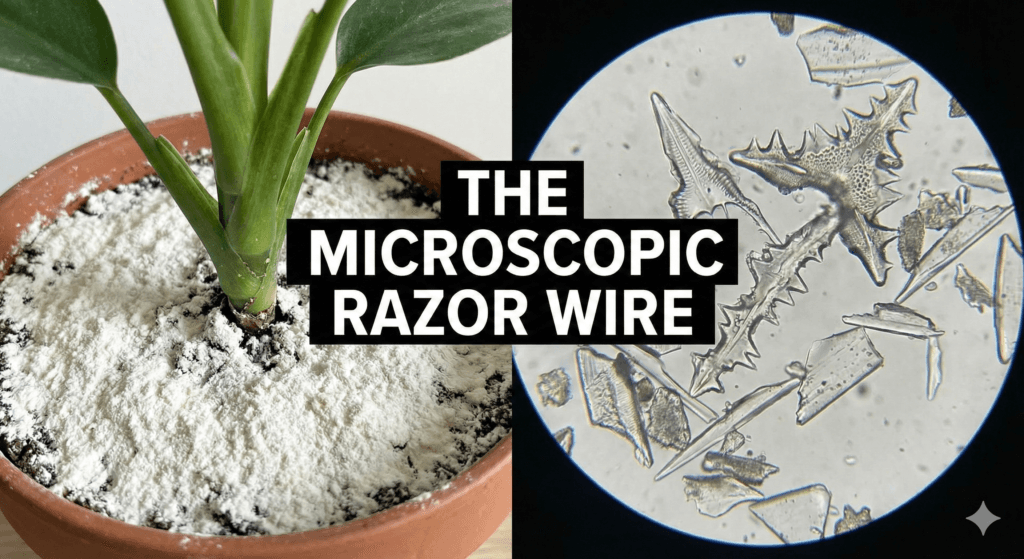
Diatomaceous Earth is not a man-made chemical. It is a geological deposit. It consists of the fossilized remains of tiny, aquatic organisms called Diatoms. These single-celled algae lived millions of years ago, and their skeletons are made of nearly pure Silica. When mined and ground into a white powder, it feels soft and chalky to human hands—like flour or talc powder.
The Engineering Secret: To us, it is soft. But under a microscope, DE looks completely different. It is not round; it is cylindrical, porous, and has razor-sharp edges. Imagine a microscopic shard of glass or a jagged piece of coral. While it is harmless to your soft skin, for an insect with a hard exoskeleton, it is a microscopic death trap.
2. The Mechanism of Death: Desiccation (Not Poison)
Traditional chemical sprays (neonicotinoids or pyrethroids) attack an insect’s nervous system. The problem? Insects evolve. They build biological resistance to chemicals over generations, forcing you to buy stronger and more toxic poisons every year.
Insects cannot build resistance to Diatomaceous Earth. Why? Because the attack is mechanical, not chemical. You cannot “evolve” resistance to being cut in half.
Here is the brutal engineering process of how it works:
- Contact: An insect (like a fungus gnat larva, ant, or beetle) crawls over the fine white powder.
- Abrasion: The microscopic silica shards act like sandpaper. They cut through the waxy outer layer (cuticle) of the insect’s exoskeleton.
- Absorption: DE is highly porous and acts like a super-sponge. Once the protective waxy layer is breached, the powder immediately starts absorbing the insect’s body fluids (lipids).
- Death: The insect doesn’t die from toxins; it dies from Desiccation. It literally dries out and turns into a husk.
3. The Target List: What Does It Kill?
DE is a broad-spectrum mechanical killer. It is devastatingly effective against any insect with an exoskeleton that crawls:
- Fungus Gnats: The #1 enemy of houseplants. The larvae live in the top inch of soil.
- Aphids: The soft-bodied sap-suckers on your vegetable garden.
- Ants: It destroys their trails and kills the scouts, stopping the invasion.
- Japanese Beetles: It penetrates their hard, metallic shells.
- Slugs & Snails: While they don’t have shells, the powder dries out their slime trails instantly, creating a barrier they refuse to cross.
⚠️ Pollinator Warning: Because DE is a non-selective mechanical killer, it can also hurt bees and butterflies. Never apply DE to flowers. Only apply it to the soil or leaves when bees are not active (late evening).
4. How to Use It: The “Soil Shield” Protocol
The biggest mistake homeowners make is treating DE like a chemical spray. It is not. It is a physical barrier. Here is the engineer-approved method for the most common problem: Fungus Gnats.
Step 1: Dry the Soil DE has one weakness: Water. If it gets wet, it loses its sharp edges and absorptive power. Wait until the top inch of your potting soil is completely dry to the touch.
Step 2: The “Snow Layer” Don’t just sprinkle a pinch. You need to create a continuous barrier. Cover the entire surface of the soil with a layer of DE about 1/4 inch thick. It should look like fresh snow.
- The Logic: Adult gnats cannot dive into the soil to lay eggs without dying. And the larvae already in the soil? When they try to crawl up to the surface to become adults, they hit the “razor wire” layer and die. You break the life cycle instantly.
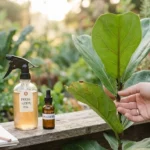
Step 3: The “Wet Application” Trick (For Leaves) To coat the underside of leaves for aphids, you can actually mix DE with water in a spray bottle (1 tablespoon per liter). Spray the plant.
- Wait, didn’t you say it must be dry? Yes. When you spray it, it is inactive. But once the water evaporates, it leaves behind a fine, dry film of powder on the leaf. This is the safest way to apply it without inhaling dust.
5. Critical Safety Warning: “Food Grade” Only
This is the most important part of this article. If you go to buy DE, you will find two types. Do not make a mistake here.
- Filter Grade (Pool Grade): This is for swimming pool filters. It has been heat-treated (calcined) and turned into crystalline silica (glass). NEVER use this. Breathing it is dangerous for your lungs and can cause silicosis.
- Food Grade: This is the natural, unheated (amorphous) version. It is so safe that it is used in grain storage to keep bugs out of the wheat you eat. This is the ONLY type you should use in your garden.
Safety Gear: Even with Food Grade DE, avoid breathing the dust. It is irritating to the throat. Wear a simple N95 mask when applying the dry powder.
Conclusion: Let Geology Do the Work
Gardening shouldn’t be a chemical warfare zone. Nature has provided us with powerful tools if we know where to look. By using Diatomaceous Earth, you aren’t just killing pests; you are using a geological marvel to protect your biological investments. Put down the spray bottle. Pick up the fossils. And watch the pests disappear.