Scroll through any gardening forum, Pinterest board, or social media feed, and you will eventually see the same piece of viral advice: “Dump your leftover coffee grounds directly onto your garden soil! It’s free fertilizer, it repels pests, and your plants will love it!”
As a result, millions of well-meaning homeowners are dutifully emptying their French presses and espresso pucks directly onto the base of their roses, tomatoes, and indoor houseplants.
But as a Forest Engineer, I look at soil through the lens of chemistry and biology, not internet trends. While coffee grounds do contain valuable organic matter, dumping them straight onto your topsoil is one of the most misunderstood practices in modern gardening. It can actually stunt your plants, repel water, and introduce natural toxins into your soil.
Let’s separate the engineering truth from the internet myths and look at the actual science of coffee grounds in the garden.
Myth 1: “Coffee Grounds Make the Soil Acidic”
The most common reason people put coffee around acid-loving plants (like blueberries, azaleas, or hydrangeas) is the belief that the grounds will lower the soil’s pH.
The Science: Coffee beans are highly acidic. However, acidity is water-soluble. When you brew a cup of coffee, almost all the acid washes into your mug. The leftover used grounds that you are left with are actually very close to neutral (typically possessing a pH between 6.5 and 6.8).
Dumping used coffee grounds on your hydrangeas will not magically turn them blue. If you want to change your soil’s pH, you need elemental sulfur, not a leftover latte.
Myth 2: “It is an Instant Nitrogen Fertilizer”
Coffee grounds are indeed rich in Nitrogen (about 2% by volume), which is a critical macronutrient for leafy plant growth. People assume that sprinkling it on the soil acts like pouring liquid fertilizer on the roots.
The Science: Plants cannot “eat” coffee grounds. The nitrogen in coffee is locked inside complex organic molecules. Before a plant can absorb a single drop of that nitrogen, the coffee grounds must be completely broken down and digested by soil microbes, bacteria, and earthworms. This decomposition process takes months. It is not a quick fix for a yellowing plant; it is a slow-release, long-term soil amendment.
The Danger 1: The “Caffeine Toxicity” Factor (Allelopathy)
Here is the dark side of coffee grounds that no internet hack mentions: Caffeine.
Why does the coffee plant produce caffeine in the first place? It doesn’t do it to help humans wake up. In nature, caffeine is a biological weapon. It is a natural pesticide and herbicide.
This mechanism is called Allelopathy. The coffee plant drops caffeine-rich leaves and seeds to the ground to suppress the germination and root growth of competing plants nearby.
While brewing removes most of the caffeine, some remains in the grounds. If you heavily mulch seedlings, seeds, or sensitive young plants with coffee grounds, the residual caffeine can severely stunt their root development.
The Danger 2: The Hydrophobic Crust
If you have ever left a puck of espresso grounds on the counter to dry, you know what happens: it turns into a rock-hard brick.
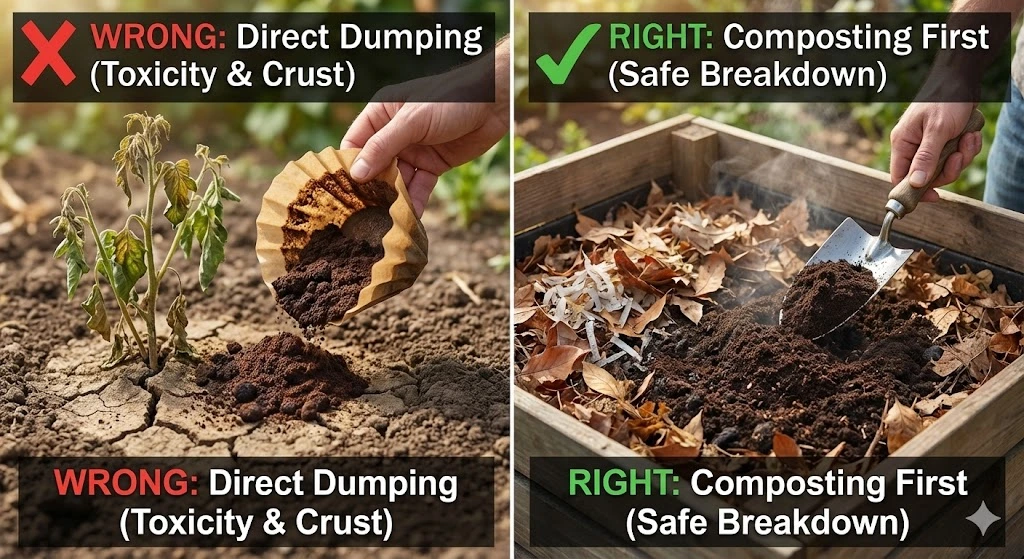
Coffee grounds consist of extremely fine particulates. When you spread a thick layer of them directly over your garden soil and the sun dries them out, they interlock to form an impenetrable, crusty shell.
In soil engineering, we call this a hydrophobic (water-repelling) layer. When you try to water the plant, the water will simply run off the surface of the coffee crust instead of penetrating down to the roots. Furthermore, this crust blocks oxygen exchange, suffocating the soil microbiome below.
The Engineer’s Solution: How to Actually Use It
Does this mean you should throw your coffee grounds in the trash? Absolutely not. They are a fantastic source of organic material, but they require processing.
The Golden Rule: Compost It First.
Do not put coffee grounds on the soil; put them in the compost bin.
In the science of composting, coffee grounds are considered a “Green” (nitrogen-rich material), despite their brown color. To use them safely and effectively:
- Mix with “Browns”: Combine your coffee grounds with carbon-rich “Browns” like dry leaves, shredded newspaper, or wood chips (at a ratio of about 4 parts carbon to 1 part coffee).
- Let the Microbes Work: The bacteria in the compost pile will break down the toxic caffeine, neutralize any remaining acidity, and unlock the nitrogen.
- Apply the Result: After a few months, you will be left with rich, black, crumbly compost (“Black Gold”) that you can safely spread around any plant in your garden without the risk of hydrophobic crusts or stunted roots.
Conclusion: Stop the Direct Dump
Your garden is a complex biological engine. You wouldn’t pour unrefined crude oil into your car’s gas tank; it needs to be processed into gasoline first. Similarly, do not pour unrefined coffee grounds directly onto your soil. Process them through your compost pile first, and let nature do the engineering.