
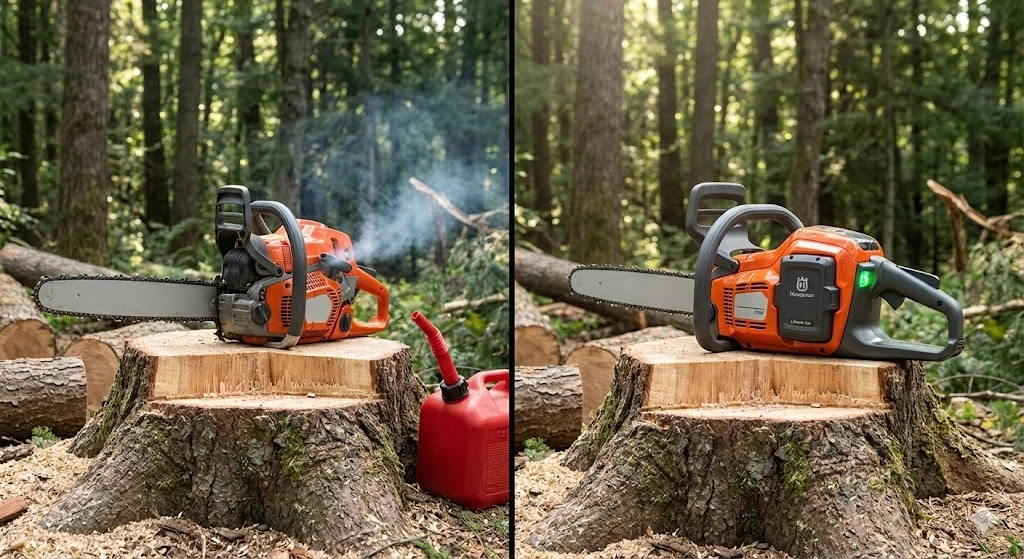
Five years ago, if you brought a battery-powered chainsaw to a logging site, the seasoned lumberjacks would have laughed you right out of the forest. Early electric saws were viewed as plastic toys—fine for trimming a rogue lilac bush in the suburbs, but utterly useless against a mature oak tree.
But technology moves fast. Today, the landscape of power equipment is undergoing a massive shift. High-voltage lithium-ion batteries paired with advanced brushless motors have changed the laws of portable physics.
As a Forest Engineer, I no longer look at battery chainsaws with skepticism. I look at them with profound respect. But the ultimate question remains for the serious homesteader or property owner: Are they actually powerful enough to fell a real tree?
Here is the engineering truth about gas vs. battery, the physics of cutting torque, and the reality of taking a battery-powered saw into the woods.
1. The Physics of Torque: Brushless Motors vs. Internal Combustion
To understand if a saw can fell a tree, we have to look at how it generates power.
The Gas Engine (The Power Curve): A traditional 2-stroke gas chainsaw relies on internal combustion. To get maximum power (torque) to the chain, the engine needs to reach peak RPMs. If you bury a gas saw into a thick, wet piece of hardwood without keeping the revs high, it will bog down and stall. You have to “ride the clutch” and keep the engine screaming to maintain cutting force.
The Brushless Electric Motor (Instant Torque): A modern professional battery chainsaw (like a 36V Stihl or 40V Husqvarna) uses a magnetic brushless motor. In engineering terms, an electric motor does not have a “power curve.” It delivers 100% of its maximum torque at 1 RPM.
When you pull the trigger on a high-end battery saw, the chain does not need to spool up to cut. The moment the teeth touch the wood, the magnetic stator drives the chain through the fibers with unrelenting, continuous force. For making a precise felling notch (the directional cut), this instant, predictable torque is an absolute dream.
2. The Reality of Felling with a Battery
So, can it fell a tree? Yes. Absolutely.
Modern professional-grade battery saws (comparable to a 40cc to 50cc gas saw) can easily drop trees up to 15 to 18 inches in diameter. When equipped with a sharp, narrow-kerf chain, a battery saw will glide through pine, ash, and even dense oak with surprising aggression.
However, felling the tree is only 10% of the job. The real test is what comes next.
3. The Thermal Limit: Where Gas Still Wins
Here is where the engineering reality sets in. Once the tree hits the ground, you have to “buck” it (cut the main trunk into firewood logs) and “limb” it (remove all the branches). This requires sustained, heavy-duty, continuous cutting.
- The Battery Drawback: When an electric motor is placed under sustained heavy load (like ripping through a 20-inch trunk for 10 minutes straight), it generates massive amounts of heat. Lithium-ion batteries have safety sensors. If the battery gets too hot, it will trigger a “thermal throttle” and shut the saw down to prevent a fire or permanent cell damage. You are forced to stop and wait for it to cool.
- The Gas Advantage: A 70cc professional gas saw does not care about sustained loads. As long as there is fuel in the tank and the cooling fins are clean, you can bury the bar in solid hardwood all day long.
Furthermore, you can refill a gas tank in 30 seconds. Recharging a massive 8Ah battery takes an hour or more. If you are deep in the woods, you need to carry three or four heavy, highly expensive batteries to equal a single $5 can of mixed fuel.
4. The Ergonomic and Safety Triumphs
Despite the thermal limits during heavy bucking, battery saws offer massive advantages for the average property owner and arborist:
- Zero Idle Danger: A gas saw is always running, vibrating in your hands, and making noise even when you aren’t cutting. When you let go of the trigger on a battery saw, the machine is dead silent and completely safe. This allows you to communicate with your felling partner without shouting over a screaming engine.
- No Pull Cords: If you are balancing on uneven terrain or standing in thick brush, trying to pull-start a flooded gas saw is exhausting and dangerous. A battery saw starts with the push of a button, every single time.
- Vibration and Exhaust: Prolonged use of gas saws leads to Hand-Arm Vibration Syndrome (HAVS) and forces you to breathe toxic 2-stroke exhaust. Battery saws run incredibly smooth and emit zero fumes, preserving your long-term health.
Conclusion: The Engineer’s Verdict
If you are a professional logger clear-cutting massive timber all day, gas internal combustion is still the undisputed king.
But if you are a homeowner, a farmer, or an occasional firewood cutter needing to fell dead trees, clear storm damage, or manage a suburban woodland, a high-end battery chainsaw is not just powerful enough—it is actually the superior choice.
It is cleaner, requires zero engine maintenance, starts instantly, and possesses more than enough torque to bring a medium-sized tree safely to the ground. Welcome to the future of forestry.