You finally designed the perfect wooden deck for your backyard. You submit your plans to the local municipality, expecting a quick permit, but instead, you hit a brick wall: “Please provide a certified Arborist Report and a Tree Protection Plan.” Suddenly, your simple weekend DIY project feels like a massive bureaucratic headache. Why does the city care so much about a few wooden planks near a tree?
As a Forest Engineer, I see homeowners panic over this exact issue all the time. But here is the good news: an arborist report isn’t a rejection letter. It’s a blueprint to ensure your new deck doesn’t accidentally kill your beautiful, mature trees—or cause them to crash into your living room five years from now.
In this guide, we will break down exactly what a Tree Protection Plan (TPP) is, when you actually need one, and the engineering secrets to getting your deck approved without harming your trees.
Why Does the City Care About Your Deck? (The Invisible Danger)
When most people look at a tree, they only see the trunk and the branches. But the real structural integrity of a tree lies underground.
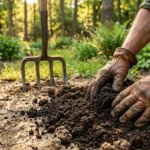
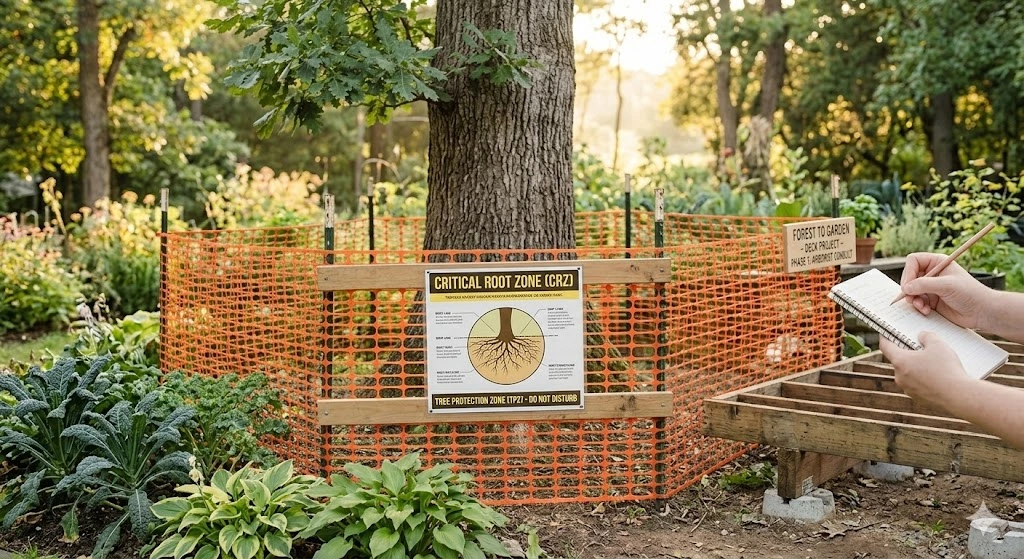
The most vital part of a tree’s root system is called the Critical Root Zone (CRZ). These roots act like the anchor of a massive ship. When you dig standard 12-inch concrete footings (sonotubes) for your deck, you are essentially severing these primary anchor roots.
Cutting just one major structural root can destabilize a 60-foot oak tree, making it highly susceptible to blowing over in the next heavy storm. Furthermore, the heavy foot traffic and machinery used during construction compact the soil, suffocating the roots that need oxygen to survive. Municipalities require an arborist report to prevent these delayed, disastrous tree failures.
When Exactly Do You Need an Arborist Report?
Not every backyard project requires a city arborist to visit your property. However, you will almost always trigger the need for a Tree Protection Plan if your project falls under these three conditions:
- The Proximity Rule (Digging within the CRZ): If your deck’s footprint falls within the tree’s drip line (the area directly under the outer circumference of the tree branches), or generally within 15 feet of a mature tree trunk, the city will flag it.
- Heritage or Protected Species: Many cities have strict local ordinances protecting specific native or historical trees. If you have an ancient Oak, Redwood, or Maple in your yard, any construction nearby requires professional oversight.
- Heavy Machinery Usage: If your deck construction requires bringing in mini-excavators or skid steers that will drive over the root zone, the city will demand a plan to prevent soil compaction.
What is Inside a Tree Protection Plan (TPP)?
If you hire an arborist, they aren’t there to stop your project. They are there to map out a safe construction zone. A standard Arborist Report and TPP will include:
- Visual Tree Assessment (VTA): The arborist will document the tree’s current health, species, and structural integrity.
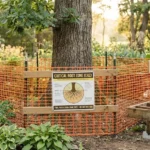
- Tree Protection Zone (TPZ) Fencing: The report will specify exactly where temporary chain-link fencing must be installed to keep contractors and materials away from the roots.
- Ground Protection Measures: If workers must walk near the tree, the arborist might require laying down thick mulch or plywood to distribute the weight and prevent soil compaction.
An Engineer’s Secrets: How to Build Your Deck and Save the Tree
Here is the part most basic landscaping blogs won’t tell you. If you want to easily pass your arborist inspection and get your permit approved quickly, use these tree-friendly engineering alternatives instead of traditional concrete footings:
1. Ditch the Concrete, Use Helical Piers
Traditional concrete footings require digging massive holes, which destroys roots. Instead, propose using Helical Piers or pin foundations (like Diamond Piers). These act like massive screws driven into the ground. They slide right past major tree roots without severing them. Arborists love this solution, and it often guarantees a fast approval.
2. Design a Cantilever Deck
If a tree is too close to your deck’s edge, use a cantilever design. This means setting your support posts further back (away from the tree) and allowing the deck’s joists to overhang toward the tree. You get the deck size you want, and the tree’s roots remain completely untouched.
3. Opt for Permeable Decking
Trees need rainwater to filter down into their roots. If you build a massive, water-tight structure over the root zone, the tree will slowly die of thirst. Ensure your deck boards have traditional gaps, allowing rain and oxygen to naturally reach the soil below.
Final Thoughts: Don’t Let the Paperwork Stop You
Getting a letter from the city demanding a Tree Protection Plan can feel overwhelming, but it is just a standard part of responsible urban engineering. By understanding the Critical Root Zone and utilizing smart foundation alternatives like helical piers, you can build your dream deck while keeping your ancient trees standing tall for decades to come.
(Have you ever had a tree slowly die after a backyard construction project? Let us know in the comments, and don’t forget to check out our guide on the biggest mulching mistakes that might be killing your yard trees right now!)