
Here is the expanded, 600+ word version of the blog post. I have added a section on Maintenance (Sanitation)—a critical engineering protocol for preventing disease spread—and deepened the mechanical explanations to make this a definitive guide.
Stop Crushing Your Plants! The Engineer’s Guide to Buying the Right Pruning Shears (Bypass vs. Anvil)
Category: Garden Tools / Plant Health Reading Time: 6 Minutes
You walk into the hardware store on a Saturday morning. You need a pair of pruning shears to trim your roses. You stand in the aisle and see two models that look almost identical. One is $15. The other is $60. You grab the cheap one. You think: “It’s just a pair of scissors. How different can they be?”
Congratulations! You likely just bought a tool that will “chew” your rose bushes instead of cutting them. As a Forest Engineer, I don’t classify garden tools by their price tag or their handle color. I classify them by their Physics.
The most common mistake gardeners make is ignoring the fundamental mechanical difference between the two main types of shears: Bypass and Anvil. Using the wrong one is like trying to cut a steak with a spoon. You might get through the meat eventually, but it won’t be pretty. Here is the engineering breakdown of why you need specific tools for specific tissues.
1. Bypass Pruners: The Surgeon’s Scalpel
These are the most important tool in your kit.
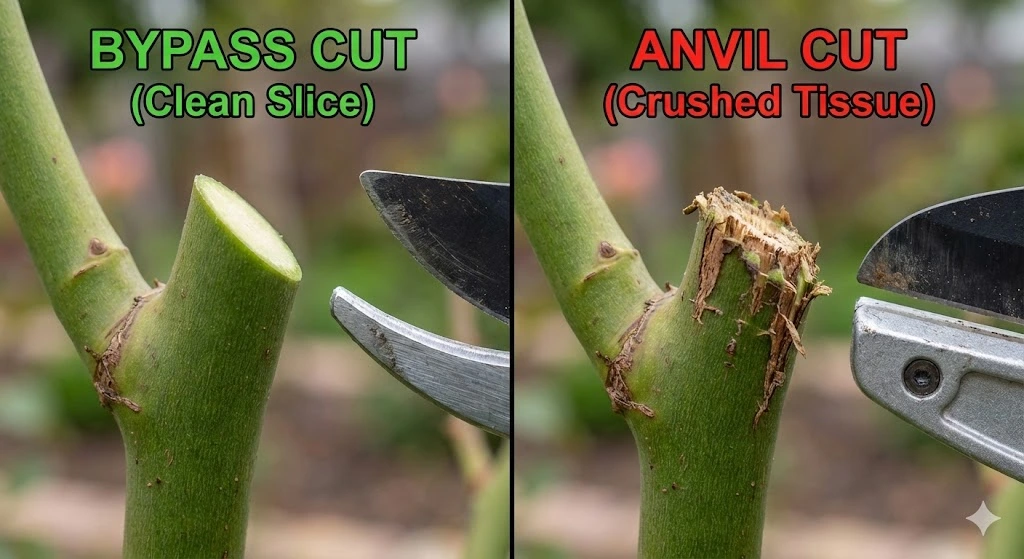
- The Mechanics: They work exactly like a pair of scissors. Two curved blades pass by each other. The sharp top blade slices through the wood while sliding past the thick, unsharpened counter-blade (the hook).
- The Physics: This utilizes Shearing Force. The blade creates a single, clean plane of separation.
- Use For: LIVE, GREEN wood.
- The Biology: When you cut a live stem, you are performing surgery. You are severing the Cambium Layer (the vascular system). Because the blades pass each other, a Bypass pruner makes a perfectly clean cut without bruising the remaining tissue.
- Why it matters: A clean cut heals in days. A bruised cut (where the bark is crushed) dies back, turns black, and becomes an entry point for bacteria and rot (Necrosis). If you are pruning roses, fruit trees, or anything you want to keep alive, you MUST use Bypass.
2. Anvil Pruners: The Butcher’s Knife
These look tougher and usually have a straight blade.
- The Mechanics: They have one straight, sharp blade that comes down onto a flat, wide metal block (the anvil). It works exactly like a chef’s knife hitting a cutting board.
- The Physics: This utilizes Crushing Force.
- Use For: DEAD, DRY wood.
- The Danger: If you use this on a live green stem, the soft tissue gets crushed against the anvil before it is cut. The blade smashes the delicate capillaries and xylem tubes.
- The Result: You leave behind a “stump” of crushed, dead tissue. This acts like gangrene. The rot will travel down the stem, killing the bud below the cut.
- The Advantage: However, for dead wood (like old, hard branches), Anvil pruners are superior. They are powerful and the blade won’t twist or get stuck in hard wood like a Bypass pruner might.
3. Material Science: Carbon vs. Stainless
Don’t just look at the handle; look at the metal.
- Stainless Steel: It won’t rust, which is nice for lazy gardeners. But structurally, stainless steel is a softer alloy. It loses its razor edge quickly and is notoriously difficult to sharpen. A dull blade damages plants.
- High Carbon Steel (SK-5): This is the Engineer’s Choice. It is incredibly hard (High Rockwell Hardness). It takes a razor edge and holds it for a long time.
- The Trade-off: It will rust if you leave it wet.
- The Fix: A true engineer cleans their tools. A drop of oil (WD-40 or Camellia Oil) after use prevents rust perfectly. Sharpness is the #1 factor for plant health.
4. Sustainability: The “Replaceable Part” Test
Before you buy, look at the central screw (the fulcrum). Is it a bolt with a nut, or is it a permanent rivet?
- Avoid Rivets: This is “Planned Obsolescence.” If the blade chips or the spring breaks, you have to throw the whole tool in the trash.
- Choose Bolts: A professional tool (like the Swiss-made Felco or Japanese Okatsune) is fully modular. You can replace the blade, the spring, the shock absorbers, and even the screws.
- The Investment: You buy the tool once for $60, and you maintain it for life. I have pruning shears that are 20 years old and cut better than new ones.
5. The Engineer’s Hygiene Protocol
Finally, a note on biology. Pruning shears are the #1 vector for spreading disease between plants. If you cut a rose with Black Spot and then cut a healthy one, you just inoculated the healthy plant.
- The Protocol: Keep a small spray bottle of 70% Isopropyl Alcohol or a jar of Lysol wipes in your pocket.
- The Habit: Wipe the blades between every single rose bush or tree. It takes 5 seconds, but it saves your garden from viral collapse.
Conclusion: You Need Both
There is no “one tool to rule them all.”
- Keep a razor-sharp Bypass Pruner in your holster for your live roses, fruit trees, and soft green shrubs.
- Keep a rugged Anvil Pruner in your shed for clearing out dead wood, dry branches, and thick hacking jobs.
Respect the biology of the plant by using the physics of the right tool.