Here is the expanded, 600+ word version of the blog post. I have added specific biological details about invasive species competition (a major issue for bird lovers) and a maintenance schedule to make this a complete guide for attracting wildlife.
Why Your Birdhouse is Empty: The 4 Fatal Engineering Errors Preventing Birds from Moving In
Category: Wildlife Gardening / Habitat Engineering Reading Time: 5 Minutes
You bought a charming, painted wooden cottage to hang in your garden. It has a cute little roof, maybe even some decorative shutters. You hung it up with excitement, imagining a family of colorful Blue Tits or Chickadees raising their young right outside your window. You waited for weeks. Then months. But no birds ever moved in. The box sits there, empty and silent.
Why? Are the birds ungrateful? No. They are survivalists. What looks like a “cute home” to you, likely looks like a “Thermal Oven” or a “Predator Trap” to a bird. Birds have evolved over millions of years to detect unsafe nesting sites. If your box fails their safety inspection, they will ignore it.
As a Forest Engineer, let me explain the real estate criteria of wild birds. If your birdhouse is empty, you are likely committing one of these 4 fatal engineering errors.
1. The Fatal Flaw: The “Perch of Death”
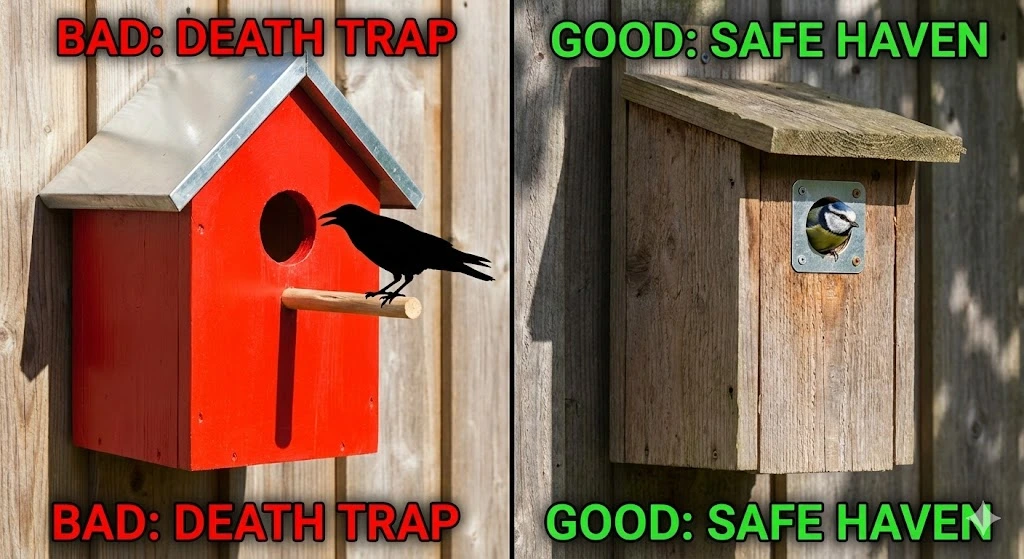
Look at almost any commercial birdhouse sold in a gift shop. Does it have a little wooden stick (perch) below the entrance hole? Remove it immediately. Saw it off.
Birds do not need a perch to enter a nest. They are incredibly agile fliers; they can fly straight into the hole or cling to the rough wood face with their sharp claws (like a woodpecker). So, who is that perch designed for? Predators.
- The Threat: Crows, Magpies, Jays, and even domestic cats use that convenient little stick to stand on. It gives them leverage to reach inside, grab the eggs or hatchlings, and eat them.
- The Verdict: That perch is not a welcome mat for parents; it is a “Ladder for Burglars.” A safe birdhouse has a smooth front with no handles for predators to grab.
2. The Wrong Specs: Hole Diameter Matters
One size does NOT fit all. Birds are incredibly picky about the size of their front door. This isn’t just about comfort; it is about Exclusion. Small birds (like Tits or Wrens) want a hole exactly big enough for them, and too small for their enemies.
If the hole is too big (over 1.5 inches), aggressive invasive species like House Sparrows or Starlings will invade. They will kill the smaller native birds, destroy their eggs, and take over the box.
Engineering Standards (Drill Bit Sizes):
- Blue Tits / Chickadees: Exactly 25mm – 28mm (1.0 – 1.1 inches). They feel unsafe in anything larger.
- Great Tits / Nuthatches: 32mm (1.25 inches).
- Sparrows: 35mm+ (1.4 inches).
The Fix: If your hole is too big, you don’t have to throw the box away. You can buy a metal “Hole Reducer Plate” (predator guard) for $5. Screw it over the existing hole to shrink the entrance to the correct size.
3. Thermodynamics: The Solar Oven Effect
Where did you hang the box?
- Facing South? Mistake. A small wooden box facing the midday sun absorbs massive amounts of heat. Internal temperatures can exceed 100°F (38°C). The chicks inside can literally die from Hyperthermia (heat stroke) or dehydration.
- Facing West? Mistake. In most climates, this is the direction of driving rain and prevailing wind. The nest will get soggy, leading to hypothermia for the naked chicks.
The Engineer’s Fix: Face the entrance North, North-East, or East. This orientation catches the gentle morning sun (to warm up the chilled birds after a cold night) but avoids the scorching afternoon heat and the worst of the wet winds.
4. Sanitation: The Missing Door
Does your birdhouse have a way to open it? If not, it is a single-use item. Birds will rarely reuse a dirty nest filled with old poop, dead plant matter, and parasites. Old nests are breeding grounds for Red Mites, Fleas, and Blowfly Larvae. These parasites overwinter in the bedding and will attack the new hatchlings next spring, sucking their blood and weakening them.
The Protocol: A proper nesting box must have a hinged side, roof, or a removable floor.
- The Schedule: Every winter (January or February is best), open the box. Dump out the old nest material into the compost. Scrub the inside with boiling water (no chemicals) to kill any remaining parasite eggs. Let it dry and close it back up.
- The Result: A clean house is an occupied house.
Conclusion: Function Over Fashion
Birds don’t care about the color of the roof, the cute painted flowers, or the decorative chimney. They care about safety, thermal regulation, and hygiene.
Take down that decorative box. Saw off the perch. Measure the hole size. Face it North. Build it like an engineer, not an artist, and nature will move in.