Here is the expanded, 600+ word version of the blog post. I have added a deeper explanation of Wasp Life Cycles (specifically why they become aggressive in late summer) and expanded on the specific flower morphology to make this a complete engineering guide for a safe, pollinator-friendly garden.
How to Engineer a “Bee-Only” Garden: A Guide to Attracting Pollinators Without Inviting the Stingers
Category: Sustainable Gardening / Ecosystem Management Reading Time: 6 Minutes
If you are building a Sustainable Ecosystem, you know that bees are your best friends. They are the engine of the garden, pollinating your fruits, vegetables, and flowers. Without them, your harvest fails.
But for many homeowners, “attracting pollinators” feels like a dangerous game. They worry that a flower-filled garden will become a battlefield of aggressive wasps, hornets, and yellowjackets. They want the fuzzy, gentle bumblebee, but they fear the angry, smooth-skinned wasp that ruins the family barbecue.
As a Forest Engineer, I look at this not as a gardening problem, but as a Filter Design Problem. We want to “filter in” the productive, gentle vegetarians (Bees) and “filter out” the aggressive scavengers (Wasps).
The secret lies in understanding the biological “Search Image” of these insects. They are looking for different things. Here is how to engineer a garden that welcomes bees while being inhospitable to wasps.
1. The Color Spectrum: Visual Filtering
Bees and wasps see the world differently. Their eyes are tuned to different wavelengths of light. You can use flower color to signal who is welcome.
- The Bee Choice: Bees have trichromatic vision that is shifted toward the ultraviolet. They are naturally obsessed with Blue, Purple, Violet, and White. They cannot see the color red (it looks like black or dark gray to them).
- The Wasp Warning: Many aggressive social wasps are opportunistic foragers. While they visit flowers, they are primarily visual hunters attracted to bright, high-contrast signals.
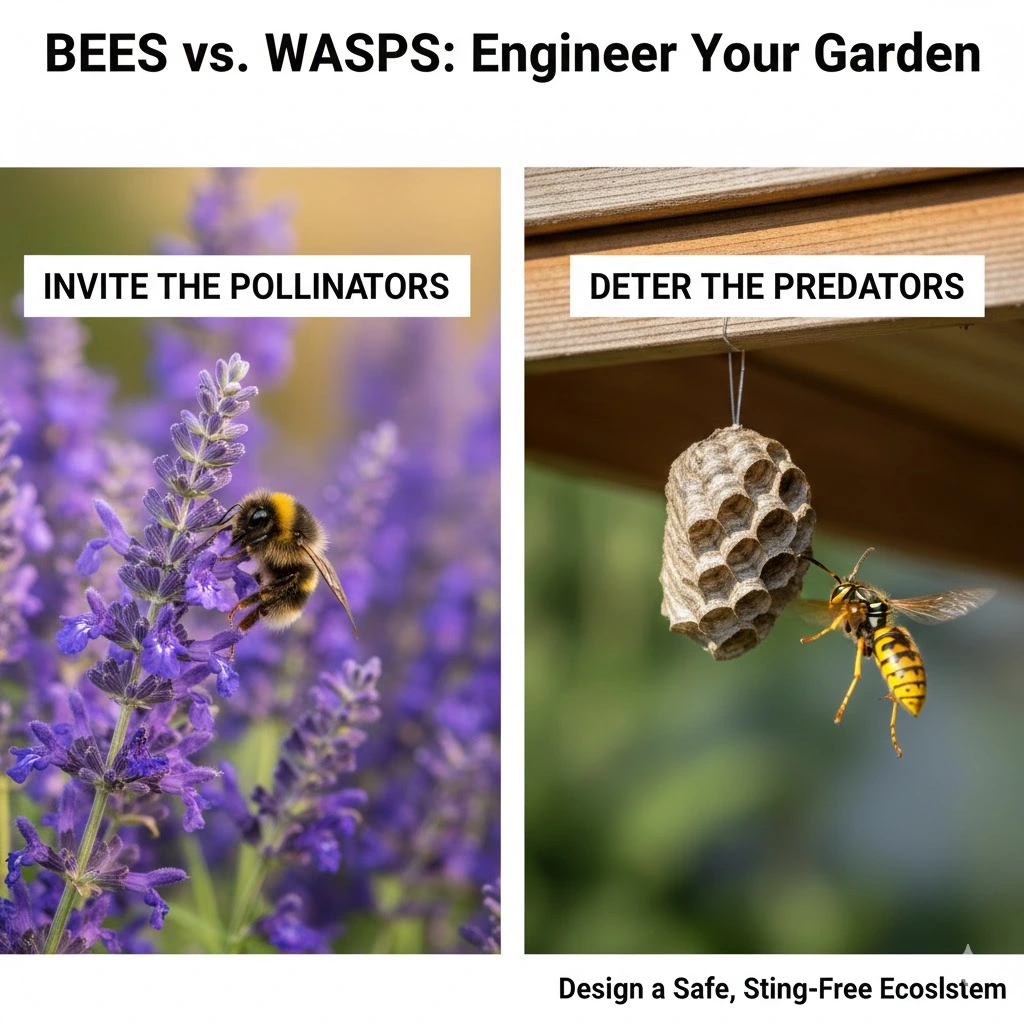
- Engineering Move: Fill your garden with a “Cool Palette.” Plant Lavender, Salvia, Catmint, Russian Sage, and Borage. This “Blue-Purple” spectrum creates a high-frequency signal for bees. It basically screams, “Food Here!” to a bee, while remaining a relatively “quiet” signal to a passing wasp looking for a caterpillar.
2. Flower Morphology: The Access Key (Mechanical Engineering)
This is pure mechanical engineering. Bees have specialized, long tongues (proboscis) and strong bodies designed to pry open complex flowers. Wasps generally have short mouthparts and are lazy feeders.
- Attract Gentle Bees: Plant flowers with tubular shapes or complex “landing pads.”
- Examples: Foxgloves, Snapdragons, Lupines, and Penstemons.
- The Mechanism: A Bumblebee is strong enough to push its way inside a Snapdragon to get the nectar. A Honeybee has a tongue long enough to reach the bottom of a Foxglove.
- Deter Wasps: Wasps prefer shallow, open-faced flowers (like large Umbellifers or flat daisies) where the nectar is exposed and easy to lick up. If you plant complex, deep flowers, the wasp will land, realize it can’t reach the food easily, and move on to an easier target.
3. Diet Management: The “Sweet vs. Meat” Rule
To control wasps, you must understand their biology. Bees are Vegetarians. They only want nectar (sugar) and pollen (protein). Wasps are Carnivores (mostly).
- Early Summer (The Protein Phase): Wasps are actually beneficial here. They hunt caterpillars and flies to feed their larvae. They rarely bother humans.
- Late Summer (The Sugar Phase): This is the danger zone. The queen stops breeding, so there are no larvae to feed. The worker wasps are now unemployed and hungry for sugar to fuel themselves. This is why they dive into your soda can or land on your watermelon.
Engineering Move: Do not leave fallen fruit (apples, pears) rotting on the ground. Fermenting fruit is a “Wasp Magnet.” By keeping your garden clean of human food waste and rotting fruit, you eliminate the primary reason aggressive wasps loiter around your patio in August.
4. Nesting Biology: “Decoy” Engineering
Wasps are fiercely territorial. You can use their own psychology against them with a simple “Visual Block.” Aggressive social wasps (like Yellowjackets and Hornets) will generally not build a nest within 200 feet of another enemy colony. They don’t want a turf war.
- The Trick: Hang a Decoy Wasp Nest (you can buy them or make one from a crumpled brown paper bag) under your eaves or in a tree in early spring.
- The Mechanism: A scouting queen wakes up in April looking for a nest site. She sees the “nest,” thinks “This territory is taken,” and flies away to your neighbor’s yard. It is a low-cost, 100% biological deterrent that requires zero chemicals.
5. Hydration Stations: The Bee Oasis
Every ecosystem needs water, but how you provide it matters.
- Avoid: Deep, open water troughs or birdbaths without islands. These are drowning traps for bees and attract wasps looking for a massive drink.
- The Design: Create a “Bee Bath.”
- Take a shallow saucer.
- Fill it with marbles, river stones, or moss.
- Fill it with water just halfway up the stones.
- The Result: This provides a safe, dry landing zone for bees to sip water without drowning. The lack of a “bulk” water surface makes it visually less attractive to large wasp colonies patrolling for a water source.
Conclusion: Balance, Not War
A sustainable garden isn’t about killing every insect you dislike; it’s about Strategic Inclusion. By engineering your plant choices (Blue/Purple), flower shapes (Tubular), and layout (Clean/Decoy), you can enjoy a garden humming with the sound of productive bees while keeping the stingers at bay.
Nature is a system of signals. Today, we just learned how to change the channel.