Here is the expanded, 600+ word version of the blog post. I have deepened the ecological explanations (specifically regarding the Carbon Cycle and Saproxylic insects) and added a section on “Green Concrete” to make this a comprehensive manifesto for the sustainable gardener.
The “Perfect” Garden is a Lie: Why Your Obsession with Tidiness is Creating a Biological Desert
Category: Ecological Gardening / Sustainable Landscaping Reading Time: 6 Minutes
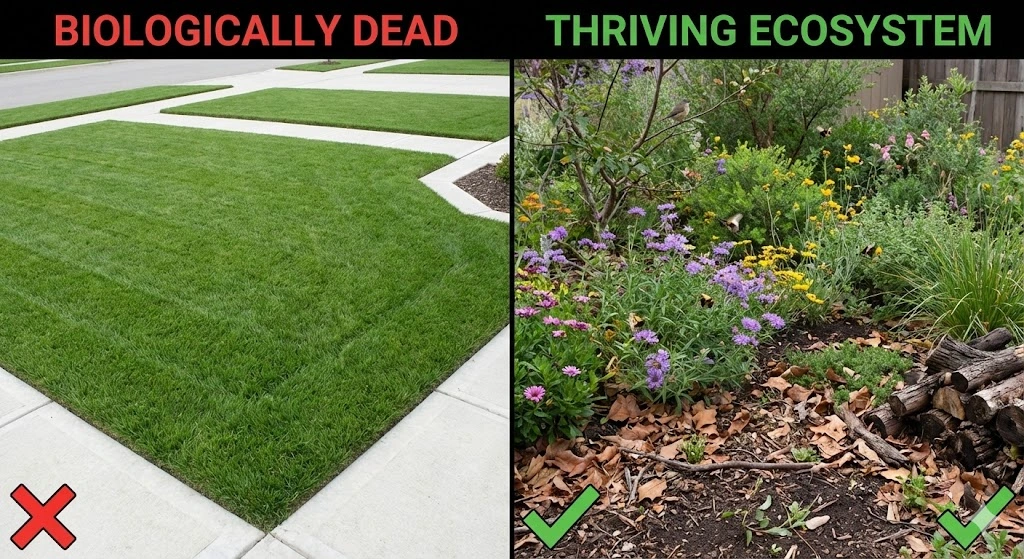
Take a walk through any modern suburb on a Saturday morning. What do you see? Manicured lawns cut to military precision. Leaf blowers roaring like jet engines, chasing away every speck of dust. And lines of black plastic bags filled with “garden waste” sitting on the curb, waiting to be hauled away.
It looks tidy. It looks controlled. To the average eye, it looks “perfect.” As a Forest Engineer, I see something completely different: I see a biological desert. I see starvation for birds, homelessness for pollinators, and a broken nutrient cycle.
We humans are obsessed with order. We want our gardens to look like our living rooms—vacuumed, sanitized, and static. But nature operates on chaos, not cleanliness. Biology is messy. When you strip your garden of every leaf, twig, and weed, you are breaking the fundamental Nutrient Cycles that keep your landscape alive. You are turning a living ecosystem into a sterile outdoor carpet.
Let’s explore why your obsession with a “clean” garden is actually killing your ecosystem, and why “Strategic Messiness” is the superior engineering solution.
1. The “Black Gold” You Are Throwing Away: Breaking the Carbon Cycle
Every autumn, deciduous trees drop their leaves. To most homeowners, this is a “mess” that needs to be cleaned up immediately. But think like an engineer for a second.
The Biology: Those leaves are solar panels that the tree spent all year building. They are packed with Carbon, Nitrogen, Phosphorus, and Potassium. The tree’s roots mined these minerals from deep within the subsoil, pulled them up, and stored them in the leaves. When you rake those leaves, bag them, and send them to a landfill, you are doing two destructive things:
- Robbing the Soil: You are permanently removing the nutrients that the tree intended to recycle back into its own root zone. You are starving the tree.
- Buying Chemicals: Next spring, you will go to the store and buy synthetic fertilizer (NPK) to replace the exact nutrients you just threw away in a plastic bag. It makes zero economic or engineering sense.
The Engineering Reality: In a forest, no one fertilizes the trees. Why? Because the leaves decompose into “Leaf Mold,” a dark, spongy humus that holds 500% of its weight in water.
🌲 Engineer’s Pro Tip: Don’t rake. Mulch. Run your lawnmower over the leaves to shred them into tiny pieces (dime-sized). Let them settle into the grass. By spring, the soil microbes and earthworms will have eaten them, turning them into free, high-grade fertilizer.
2. Dead Wood: The Apartment Complex of the Ecosystem
When you see a dead branch on the ground or a rotting log in the corner, do you immediately pick it up and burn it? You are evicting the most important residents of your garden.
In biology, there is a critical group of organisms called “Saproxylics”—creatures that depend entirely on decaying wood to survive. That ugly log you want to remove is actually a winter shelter and nursery for:
- Ladybugs: The police force that eats your aphids.
- Solitary Bees: The gentle pollinators that ensure your tomatoes grow.
- Fireflies: The magical lights of summer (their larvae live in rotting wood).
- Beetles: The base of the food chain for robins and woodpeckers.
When you sanitize your garden of all dead wood, you leave these beneficial insects homeless. And when the pests (like aphids) arrive in spring, there are no predators left to stop them.
🌲 Engineer’s Pro Tip: Create a “Habitat Pile.” Stack a few logs in a hidden, shady corner of your garden and leave them alone. Let them rot. This simple structure is far more valuable to the local ecosystem than any expensive “Bug Hotel” you can buy online.
3. The “Sterile Soil” Syndrome (Green Concrete)
A garden where every weed is pulled and the soil is left bare is a garden on life support. Soil should never be naked. In a healthy ecosystem, “Pioneer Plants” (what you call weeds) cover the ground to protect it from erosion and UV radiation.
Take Clover, for example. Many homeowners spend millions on herbicides trying to kill clover in their lawns.
- The Engineering Truth: Clover is a Nitrogen Fixer. It has a symbiotic relationship with bacteria in its roots that pulls Nitrogen gas from the air and converts it into plant food in the soil.
- The Benefit: Clover feeds your grass for free. When you poison the clover, you reject free nitrogen and choose to buy expensive bags of blue chemical pellets instead.
4. The Engineer’s Protocol: How to Be Lazier (and Better)
To improve your ecosystem health, you don’t need to work harder. You need to work smarter by doing less.
- Skip the Fall Cleanup: Do not cut back your perennials (Coneflowers, Sedum, Hydrangeas) in the winter. Those hollow stems are where native bees sleep. The seed heads are winter food for Goldfinches. Wait until late spring (after the last frost) to tidy them up.
- Leave the Edges Wild: Designate a “No-Go Zone” at the back of your property. Don’t mow it. Don’t rake it. Let the nettles and wildflowers grow. This becomes a reservoir for biodiversity that will spill over into the rest of your garden.
- Put Down the Pesticide: In an ecosystem, there is a lag time between Predator and Prey. If you spray poison the moment you see an aphid, you also kill the ladybug that was coming to eat it. Nature balances itself within 14 days. Be patient.
Conclusion: Update Your Aesthetic
A “perfect,” sterile garden is like a patient in a hospital bed—it requires constant intervention (water, fertilizer, chemicals) just to stay alive. A “messy,” natural garden is a self-sustaining engineering marvel. It feeds itself, waters itself, and defends itself.
Next time you reach for the leaf blower, stop. Trust the engineering of the forest. Leave the leaves. Keep the wood. Let nature do the work.ineering of nature. Leave the leaves. Keep the wood. And let your garden be a little bit wild.