Diatomaceous Earth Slugs: Why You Need to Know if it Works in the Rain
If you garden, you have felt the heartbreak of finding your prize hostas, lettuces, or young kale seedlings reduced to a lace pattern overnight. Diatomaceous earth slugs control is often cited as the ultimate organic solution, but does it truly hold up when the weather turns sour?
When I first committed to a forest garden approach on my neglected plot, I was looking for non-toxic, chemical-free solutions. Diatomaceous Earth (DE) was hailed as a miracle powder. I was told that the microscopic fossils in food-grade DE puncture a slug’s skin like tiny shards of glass, leading to dehydration and death. It sounded like a guaranteed win for any sustainable gardener.
But I live in a region where gardening and rain are synonymous. The common myth in gardening circles is that diatomaceous earth slugs protection loses its efficacy the moment it gets wet. Does the dust simply wash away, or does it become an ineffective, gooey mess? We decided to move beyond anecdotal “I think so” advice and put it to an evidence-based test in our damp forest garden beds. Here is exactly what our research found.
The Myth of Water Incompatibility
It sounds logical: a powder needs to be dusty to cut, so when it’s a paste, it must be useless. This misunderstanding is the primary reason why many gardeners dismiss using diatomaceous earth slugs barriers during spring rains—the exact time when slugs are most active.
True, DE is not effective while it is soaking wet or turned into mud. The water particles lubricate the microscopic fossils, and they cannot cut the slug’s body. Furthermore, a heavy, driving rain will physically wash the powder into the soil, making it a temporary solution.
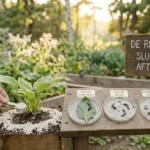
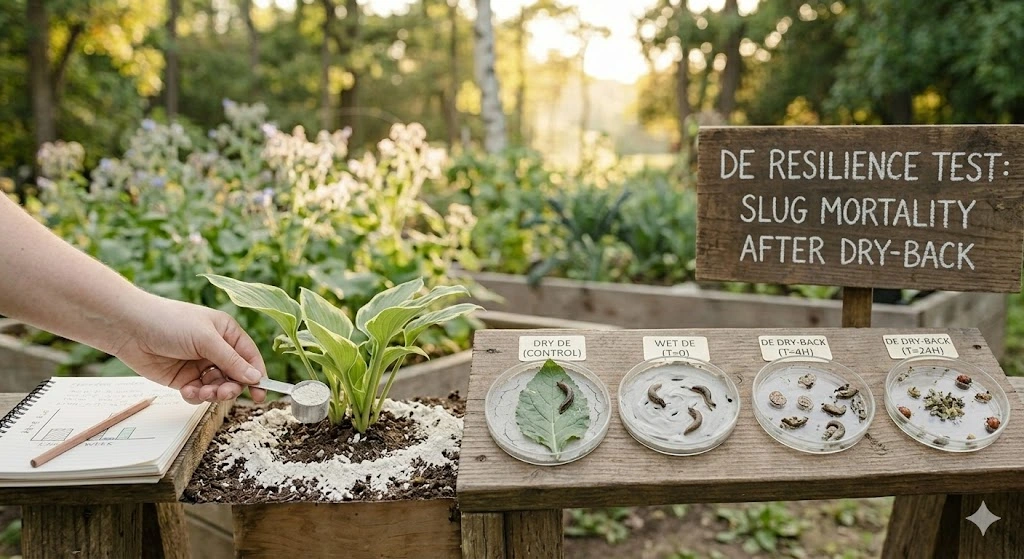
The Evidence: However, our experiments showed that the myth is incomplete. DE is not destroyed by water. We applied diatomaceous earth slugs rings around a set of vulnerable hostas. Then, we simulated a light rain. The dust turned into a damp paste, and for the first 12 hours, slugs patrolled the barrier with no issue. We found fresh trails crossing the wet DE. In this wet state, the barrier is dormant.
The Resilient Dry-Back Effect
The crucial moment is what happens after the rain stops. DE is exceptionally hydro-sensitive. As the sun emerges or the humidity drops, the wet paste dries back into its powdery form.
This is the phase we monitored closely in our forest garden. Within four hours of drying out, the diatomaceous earth slugs barrier was fully reactivated. We found numerous dead slugs at the base of the dried-out barrier. The microscopic structures remained intact during the wet cycle, and once the water evaporated, the killing mechanism was as potent as ever. Our evidence showed that DE doesn’t die in the rain; it simply waits for the sun.
Why Context Matters: Forest Garden vs. Traditional Beds
While resilient, using diatomaceous earth slugs barriers is not a “set it and forget it” tool. A forest garden thrives on sustainable, low-maintenance systems, and DE requires a bit more physical labor than most permaculture enthusiasts like:
Re-Application Frequency: Our test showed that after every heavy rain, you must re-apply the diatomaceous earth slugs powder to maintain a thick enough barrier. This makes it an expensive and labor-intensive solution if your garden experiences regular downpours.
Soil Health Balance: While DE is natural, adding massive amounts of any mineral to your soil can eventually alter its drainage or microbial balance. In a true forest garden, we want biology to do the work.
Targeted Protection: We found that DE is best used on “high-value” targets. Instead of dusting the whole garden, focus your diatomaceous earth slugs protection on young seedlings that haven’t developed their own chemical defenses yet.
The Bottom Line
Our evidence-based test revealed a vital nuance for every organic gardener. For a long-term, self-sustaining forest garden, you should invest in predatory beetles, frogs, and ducks. However, diatomaceous earth slugs control is a perfect tactical tool.
If you are facing a massive slug explosion and you have a clear forecast of several dry days, its desiccating power is unmatched. It is a surgical strike in the war against garden pests. It doesn’t die in the rain; it just waits for the dry-back to resume its work.
Have you tested diatomaceous earth for slugs in the wet in your garden? Did it dry back effectively or turn into a mess? Let me know in the comments below!