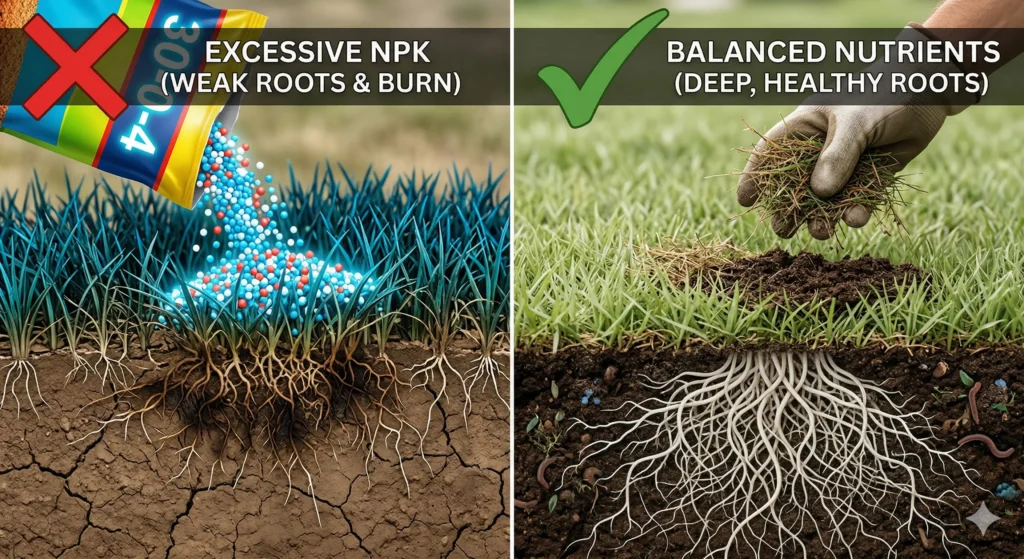
Every spring, millions of homeowners flock to garden centers and blindly grab the heaviest bags of lawn fertilizer they can find. They look at the front of the bag, see three giant numbers like 30-0-4, and assume that higher numbers mean a greener, healthier lawn.
They drag the bags home, load up the spreader, and dump massive amounts of synthetic chemicals onto their grass. Their logic is simple: “If a little fertilizer is good, a lot must be great.”
As an engineer, I view this practice as a biological and chemical disaster.
At Avcı Mühendislik, we approach soil health through data, not guesswork. When researching the cellular impact of specialized fertilizers on pine seedlings for my master’s thesis, the data revealed a strict biological rule: plants do not respond to excess; they respond to equilibrium. Over-fertilizing does not create a super-plant; it creates a structurally weak, chemically dependent lawn, while simultaneously poisoning the local water table.
If you want a truly healthy landscape, you need to stop guessing and start understanding the chemistry of the bag. Here is the scientific breakdown of the NPK ratio, and why you are probably over-fertilizing your lawn.
1. Decoding the Code: What is NPK?
Those three numbers on the front of every fertilizer bag represent the NPK ratio. They stand for the three primary macronutrients that every plant on earth needs to survive: Nitrogen (N), Phosphorus (P), and Potassium (K).
The numbers represent the percentage of that nutrient by weight in the bag. A 50-pound bag of 10-10-10 fertilizer contains 5 pounds of Nitrogen, 5 pounds of Phosphorus, and 5 pounds of Potassium. The rest of the bag is filler material (usually sand or granular limestone) to help distribute the chemicals evenly.
Here is what those elements actually do on a cellular level:
N is for Nitrogen (The Growth Engine)
Nitrogen is the primary component of chlorophyll, the molecule that makes plants green and allows them to photosynthesize.
The Effect: It drives explosive, rapid vegetative growth. It makes your grass blades tall and dark green.
The Danger: Lawn care companies push high-nitrogen fertilizers because they give you instant gratification. But forcing a plant to grow too fast creates thin, weak cell walls. Your grass might look green, but it will be highly susceptible to fungal diseases and insect attacks.
P is for Phosphorus (The Root Builder)
Phosphorus is the critical element for capturing and converting the sun’s energy into useful plant compounds (ATP).
The Effect: It stimulates deep, aggressive root development and is vital for seed germination.
The Danger: Established lawns actually need very little added phosphorus. Excess phosphorus does not absorb into the soil; it washes away in the rain, running directly into municipal storm drains. This causes massive, toxic algae blooms in local lakes and rivers. In fact, many regions have legally banned phosphorus in lawn fertilizers for this exact reason.
K is for Potassium (The Immune System)
Potassium regulates the microscopic pores on the grass blades (stomata) and controls water uptake.
The Effect: It thickens the cellular walls, making the grass highly resistant to drought, cold weather, and foot traffic. It is the plant’s immune system.
The Danger: Soils that are heavily leached or sandy often lack potassium, leading to yellowing, wilted grass that burns easily in the summer sun.
(An easy mnemonic to remember the NPK functions is “Up, Down, All-Around”: Nitrogen for the top growth, Phosphorus for the root growth down below, and Potassium for the all-around cellular health.)
2. The Disaster of the “Burn” (Nitrogen Toxicity)
Have you ever applied fertilizer and, a week later, found massive brown, dead patches scattered across your lawn? You didn’t get a bad batch of fertilizer; you chemically burned your grass.
Synthetic fertilizers are composed of mineral salts. When you apply too much nitrogen salt to the soil, it reverses the osmotic pressure in the root zone. Instead of the roots pulling water out of the soil, the high salt concentration in the soil violently sucks the water out of the plant roots. The grass literally dies of dehydration, even if it has just rained.
3. The Engineer’s Approach: Precision Over Quantity
The fertilizer industry wants you to buy their high-dose, fast-release synthetic bags every single month. To break this cycle, you must treat your lawn like an engineered biological system.
Test the Soil First: You cannot manage what you do not measure. Never apply fertilizer without performing a laboratory soil test first. The test might reveal that your soil has plenty of nitrogen, but its pH is too acidic for the grass to absorb it. In that case, adding more fertilizer is useless; you need to add lime to adjust the pH.
Switch to Slow-Release Organic: If your soil actually needs nutrients, avoid synthetic chemical salts. Choose organic, slow-release fertilizers (like milorganite, composted manure, or alfalfa meal). These require soil microbes to break them down, meaning the grass is fed slowly over 10 weeks, rather than force-fed in 10 days.
Leave the Clippings (Free Nitrogen): When you mow your lawn, do not bag the grass clippings. Let them fall back into the turf. Grass clippings are roughly 4% nitrogen. By leaving them on the lawn, you are providing 25% of your lawn’s annual fertilizer needs for free.
Conclusion: Step Away from the Spreader
A truly healthy lawn does not need to be pumped full of 30-0-4 synthetic chemicals every four weeks. It needs deep roots, a balanced pH, and a thriving microscopic soil web.
The next time you are at the garden center, ignore the marketing on the giant bags. Understand the NPK ratio, respect the chemistry of the soil, and remember that in nature, equilibrium is always more powerful than excess.