
You are standing in the power equipment aisle of your local hardware store. Spring is here, and the trees in your garden are looking a little wild. You know you need to cut some wood, but you are faced with a dilemma: Do you buy the classic, powerful chainsaw, or do you invest in the long, slightly awkward-looking pole saw?
Most homeowners default to the standard chainsaw because it looks like the ultimate tool of outdoor mastery. But as a Forest Engineer, I see the aftermath of these purchases. I see ruined trees, exhausted homeowners, and worst of all, severe emergency room injuries.
Buying the wrong motorized saw isn’t just a waste of money; it is a fundamental misunderstanding of physics, leverage, and arboriculture. Today, we are going to break down the mechanical differences between a chainsaw and a pole saw, the critical safety dynamics, and which one you actually need for your property.
1. The Chainsaw: The Ground Powerhouse
The chainsaw is the undisputed king of forestry. It is designed with one primary mechanical goal: delivering massive cutting torque to thick, dense wood.
What it is engineered for:
- Felling: Cutting down standing trees from the base.
- Bucking: Slicing a felled tree trunk into smaller, manageable firewood logs.
- Limbing (On the Ground): Removing branches from a tree that is already lying flat on the earth.
The Engineering Flaw for Homeowners: A standard chainsaw is designed to be used between your waist and your knees. When you use it within this “power zone,” your center of gravity is stable, and you can physically control the violent rotational forces of the engine.
The moment you raise a standard chainsaw above your chest to cut a branch, you have lost mechanical leverage. If the saw pinches in the wood and “kicks back” (a violent, instantaneous upward reaction), your arms do not have the geometric strength to stop it from hitting your upper body.
2. The Ladder Trap: A Recipe for Disaster
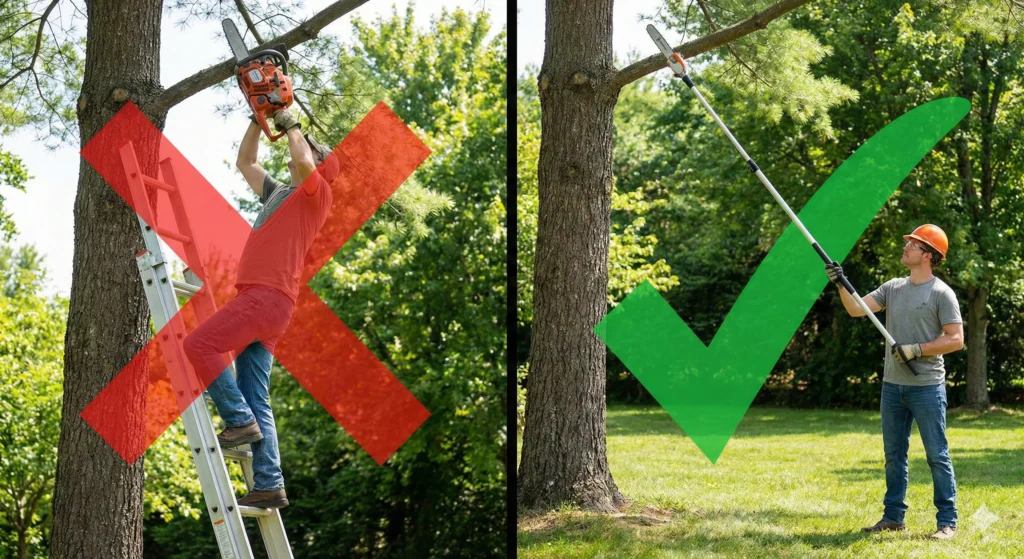
This brings us to the most dangerous landscaping mistake in the world: Taking a chainsaw up a ladder.
Let’s look at the physics. A ladder is an unstable platform with a narrow footprint. A running chainsaw spinning at 10,000 RPM generates gyroscopic forces. When you lean out from the ladder to make a cut, your center of gravity shifts outside the ladder’s footprint. When the heavy branch finally snaps, the sudden release of tension causes your body to jerk back. The ladder kicks out, and you fall—while holding a running chainsaw.
Rule of Forestry: Never, under any circumstances, use a standard chainsaw on a ladder. If your feet are not flat on the solid ground, the chainsaw should not be running.
3. The Pole Saw: The Aerial Surgeon
If you cannot take a chainsaw up into the canopy, how do you prune tall branches? You use a pole saw.
A pole saw is essentially a miniature chainsaw bar mounted at the end of a telescopic shaft (usually reaching 8 to 15 feet).
What it is engineered for:
- Canopy Pruning: Safely removing dead, diseased, or overhanging branches from mature trees.
- Clearing Lines of Sight: Lifting the canopy of a tree to let more light into the garden.
- Storm Cleanup: Cutting hanging, broken “widow-maker” branches from a safe distance.
The Engineering Advantage: The pole saw solves the center of gravity problem. It allows you to perform aerial surgery while keeping both boots firmly planted on the earth. Because the cutting head is small (usually an 8-inch to 10-inch bar), it is designed to slice cleanly through typical branch diameters (2 to 6 inches) without getting dangerously pinched.
Engineer’s Safety Note: While a pole saw keeps you off a ladder, it introduces a new hazard: gravity. The branch you cut will fall directly downward. You must always cut at an angle, stand out of the “drop zone,” and wear a hard hat.
4. The Verdict: Which One Should You Buy?
To make the right investment, look at your property like an engineer analyzing a job site.
Buy a Pole Saw If:
- You live in a suburban neighborhood with established, mature trees.
- Your primary goal is pruning low-hanging branches away from your roof, driveway, or power lines.
- You do not heat your home with a wood stove.
- Conclusion: For 80% of typical suburban homeowners, a battery-powered or gas pole saw is the only motorized cutting tool they will ever actually need.
Buy a Standard Chainsaw If:
- You live on a large, wooded, rural lot.
- You frequently need to fell dead trees, clear storm-downed trunks, or process cords of firewood.
- Your primary work is done at ground level.
The Hybrid Solution: If you truly need both, consider a “Combi-System.” Many top-tier brands (like Stihl or Echo) sell a single powerhead (the engine) that accepts different attachments. You can click in a pole saw shaft for your canopy work, and then swap it out for a string trimmer or hedge trimmer later.
Conclusion: Tool Respect
A motorized saw is not a toy; it is a high-speed cutting instrument. Buying the right tool is about matching the machine’s geometry to the biological reality of your trees.
Keep your feet on the ground, respect the physics of leverage, and always keep your chain sharp. A sharp tool is a predictable tool, and predictability is what keeps you safe.