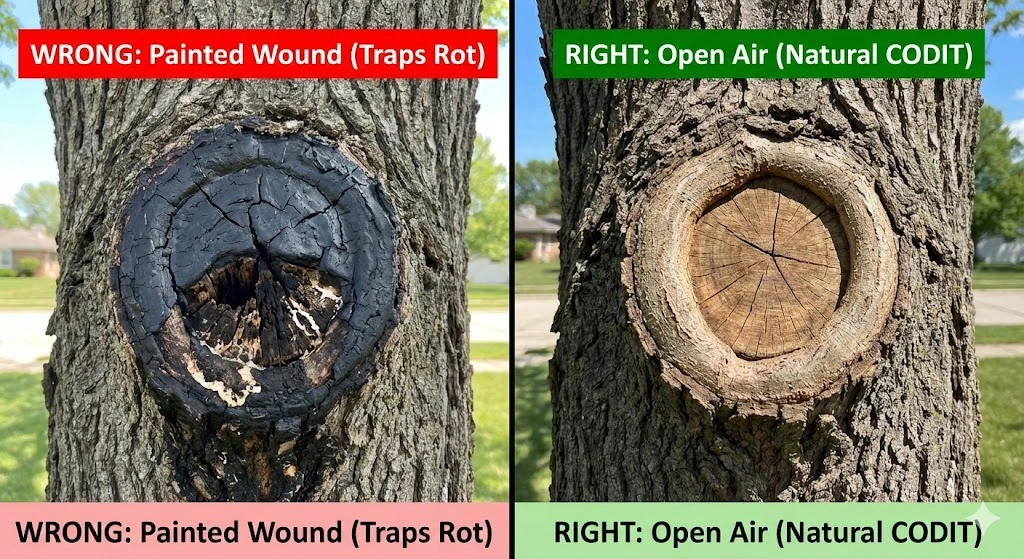
Should You Seal a Tree Wound? A Forest Engineer's Honest Answer
By Ömer Buğra Avcı, Forest Engineer (Chamber of Forest Engineers, reg. 21525) · Updated June 2026 · 6 min read
No - in nearly every case you should not seal a tree wound. A healthy tree closes its own cuts by forming callus tissue and walling off the wound, a process called compartmentalization. A sealer traps moisture against the cut and actually slows that defense down. There is exactly one exception, and it has nothing to do with healing. I'll cover it below.
Every spring I get the same question from homeowners and contractors: "I just cut a big branch - what do I paint on it?" The honest answer surprises most people, because the hardware store sells an entire shelf of tar-like "wound sealers" that promise to protect the tree. As a forest engineer, I've watched those products do more harm than the cut itself. Here is what actually happens inside the tree, and what you should do instead.
Trees don't heal - they seal
This is the single idea that changes everything. A human wound heals: new tissue regenerates and replaces what was lost. A tree cannot do that. Wood is already dead structural tissue. Instead, a tree compartmentalizes - it walls off the damaged area chemically and physically so decay can't spread inward, then grows new wood (callus) over the surface from the edges.
The forest scientist Alex Shigo described this in the 1970s with his CODIT model (Compartmentalization Of Decay In Trees), and decades of field research have confirmed it. When you understand that a tree is sealing rather than healing, the problem with wound paint becomes obvious: you're covering a surface the tree needs to keep dry and oxygenated.
What a sealer actually does to the cut
The marketing claim is "protects against disease and moisture loss." In practice, a petroleum- or asphalt-based coating does three things, none of them good:
- Traps moisture. A dark, sealed surface holds water against the exposed wood - the exact warm, damp condition fungi need to colonize.
- Slows callus formation. The film physically interferes with the new wood trying to grow inward from the wound edge.
- Cracks over time. As the coating ages it splits, letting water in but not back out, creating a sealed pocket of decay you can no longer see.
The one real exception: oak and elm
There is a single situation where a coating is justified, and it is about disease vectors, not healing. Oaks (oak wilt) and elms (Dutch elm disease) are vulnerable to fungal diseases carried by beetles that are attracted to fresh cuts. If one of these trees must be pruned during the active growing season - usually for a safety hazard that can't wait - a thin coat of water-based latex paint over the fresh cut can deter those beetles for the few critical days.
Note what this is: a temporary insect barrier on a specific genus during a specific season. It is not "healing" and it is not the tar-based sealer sold for general use. For every other tree, the cut should stay open.
What to do instead: the cut is everything
If you take one thing from this page: a tree's ability to seal a wound is decided almost entirely by where and how you cut, not by what you put on afterward. The target is the branch collar - the slightly swollen ring where the branch meets the trunk. It contains the chemical defenses the tree uses to wall off the wound.
- Find the branch collar. Don't cut flush to the trunk - that removes the collar and leaves a huge wound the tree can't close. Cut just outside it.
- Use the three-cut method on anything heavy. An undercut first, then a top cut a little further out to drop the limb, then a final clean cut at the collar. This stops the bark from tearing down the trunk.
- Use a sharp, clean tool. A ragged cut from a dull blade gives fungi more surface to enter. A clean cut from a sharp pruning saw seals faster.
- Then walk away. No paint, no tar, no sealer. A correct cut on a healthy tree is the best protection there is.
The right tool matters as much as the technique - see why a pruning saw beats a carpenter saw for tree health. Planting something new this season? Start it right with how to plant a tree correctly. And if you're dealing with an established tree, my notes on tree health and surgery go deeper.
The bottom line
Skip the sealer. Save the money, and save the tree the trouble. Make a clean cut just outside the branch collar with a sharp tool, and trust the tree's own defenses - they've had a few hundred million years of practice. The only time you reach for paint is a thin latex coat on a growing-season cut to an oak or elm, purely to keep disease-carrying beetles away.
Frequently asked questions
Should you seal a tree wound after pruning?
In almost all cases, no. A healthy tree seals its own wounds by forming callus tissue and compartmentalizing the cut. A sealer traps moisture and slows this. Make a clean cut just outside the branch collar and let the tree do the work.
Is there ever a time to use a tree wound sealer?
One narrow exception: when oaks or elms must be pruned during the growing season, a thin coat of latex paint can deter the beetles that spread oak wilt and Dutch elm disease. This is disease control, not healing.
What should you put on a tree after cutting a branch?
Nothing. What matters is the cut itself - a clean cut just outside the branch collar, not flush to the trunk, gives the tree the smallest wound to seal and the best chance to defend itself.
Does tree sap heal the wound?
Sap flow isn't "healing" in the human sense - it's part of the tree's pressure and transport system. The real defense is compartmentalization and callus growth at the wound edge, which happens whether or not sap is visible.