It is late winter, and you are staring out at the leafless trees in your garden. The branches are bare, the bark looks dry, and there is no sign of green anywhere.
As a Forest Engineer, late winter and early spring are the times I receive the most panicked phone calls. A client will tell me, “My beautiful maple tree didn’t survive the winter. It’s completely dead. I need you to come cut it down.” Nine times out of ten, when I arrive at the property, the tree is perfectly healthy. It isn’t dead; it is just “dormant.”
To the untrained eye, a dormant tree and a dead tree look exactly the same. But pulling out a chainsaw based on a visual guess is a catastrophic and expensive mistake. Before you give up on your leafless tree, you need to perform a diagnostic check.
Here is the engineering guide to understanding plant dormancy and the 4 scientific tests you can perform right now to see if your tree is dead or just sleeping.
The Science of Dormancy: The Biological “Power-Saving Mode”
First, we need to define what dormancy is. Trees do not “die” a little bit every winter and come back to life in the spring.
Dormancy is a highly complex, biological defense mechanism. When temperatures drop and the ground freezes, liquid water becomes unavailable. If a tree kept its leaves, the water inside the leaf cells would freeze, expand, and shatter the cellular walls, killing the plant.
To survive, the tree drops its leaves and enters a state of suspended animation. It pulls its vital fluids and energy reserves down into the root system, where the soil acts as an insulating blanket. Above ground, the tree shuts down its vascular system and goes into “power-saving mode.”
It looks dead, but underneath the bark, it is waiting for the temperature signal to wake up. Here is how you can check its vital signs.
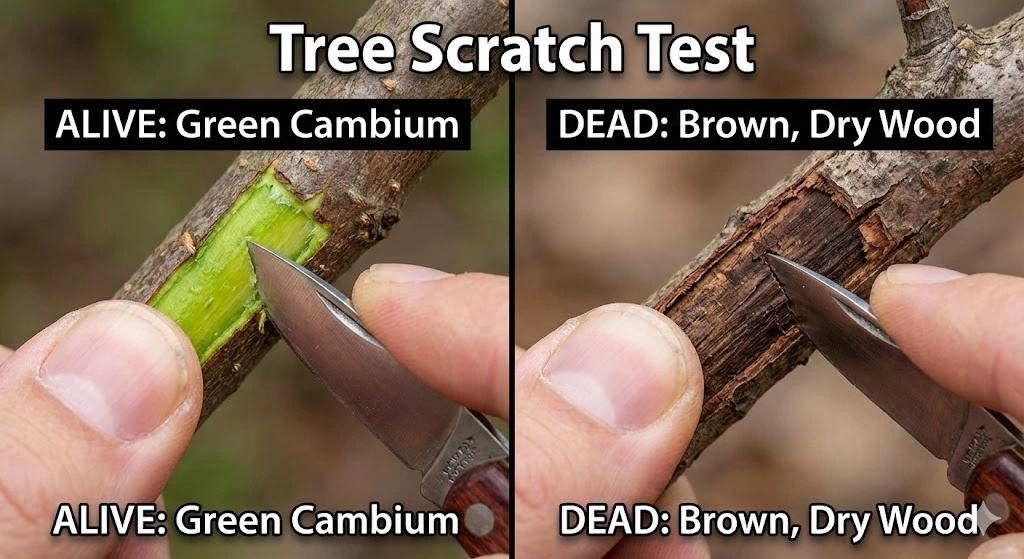
Test 1: The “Scratch Test” (Checking the Cambium Layer)
This is the single most reliable diagnostic tool in forestry. You don’t need expensive equipment; you just need a small pocket knife or your thumbnail.
Just below the hard outer bark of a tree is a microscopic, living layer of tissue called the Cambium. This is the tree’s growth factory.
- How to do it: Select a small, young twig (do not do this on the main trunk, as you don’t want to create a large wound). Gently scratch away a tiny sliver of the top bark.
- Alive (Dormant): If the tissue underneath the bark is moist and vibrant green, the tree is alive. The vascular system is intact and full of sap.
- Dead: If the tissue underneath is hard, dry, and brown or gray, that branch is dead.
Engineer’s Note: Do not rely on a single branch. A tree can have a dead branch but a perfectly healthy trunk. Perform the scratch test on 3 or 4 different twigs around the tree.
Test 2: The “Bend Test” (Testing Structural Elasticity)
Living wood and dead wood have completely different physical properties due to their moisture content. Living wood is highly hydrated, which gives it tensile strength and elasticity.
- How to do it: Grab a small branch (about the thickness of a pencil) and gently bend it back on itself.
- Alive (Dormant): A living branch is supple. It will bend deeply and eventually split along the fibers without snapping off cleanly.
- Dead: A dead branch has 0% moisture. It has lost its elasticity. When you bend it, it will immediately snap with a sharp “crack” sound, breaking completely in two.
Test 3: Bud Inspection (Looking at the Future)
Many people don’t realize this, but trees actually produce their spring buds in the autumn of the previous year. They sit on the branches all winter, wrapped in protective scales, waiting for the warmth.
- How to do it: Look closely at the tips of the branches.
- Alive (Dormant): You should see plump, firm buds. If you slice one open carefully, it will be green and fleshy inside.
- Dead: The buds will be shriveled, dry, and crumbly. If you rub them with your finger, they will turn to dust and fall off.
Test 4: Trunk and Root Inspection (The Foundation)
Sometimes the branches pass the test, but the core structural integrity of the tree is failing. You must inspect the main trunk and the root flare (where the trunk meets the soil).
Look for these critical signs of structural failure and death:
- Bark Peeling: While some trees (like Birch or Sycamore) naturally shed bark, most trees do not. If large chunks of bark are falling off the trunk, revealing smooth, dead wood underneath, the tree’s vascular system has collapsed.
- Fungal Conks (Mushrooms): If you see shelf-like mushrooms growing directly out of the bark or at the base of the roots, this is a massive red flag. Fungi only feed on decaying organic matter. If they are growing on your tree, the heartwood inside is rotting.
- Deep Cracks: Vertical cracks that penetrate deep into the wood (not just surface bark cracks) indicate severe stress, frost damage, or structural splitting.
Conclusion: Practice Patience
If you perform these tests in February or March and find green cambium and flexible branches, put your tools away and wait. Different tree species wake up at different times. An oak tree might remain dormant weeks after a cherry tree has already bloomed.
However, if the branches snap, the scratch test reveals brown wood everywhere, and the bark is falling off, the tree has unfortunately died. In that case, you must safely remove it before it becomes a brittle hazard to your home.
When in doubt, think like an engineer: gather the data, perform the tests, and never cut down a tree based on a guess.