
When you walk into a home goods store to buy a vase, what do you look for? The color? The modern shape? The price tag?
If you are like most people, you treat a vase as a decorative object that just happens to hold water. As a Forest Engineer, I see it differently.
To me, a vase is not just a decoration. It is a temporary life support system for a living organism that has been severed from its roots. The moment a flower is cut, it enters a race against time, battling bacteria, dehydration, and gravity.
The wrong vase will speed up this death, turning your expensive bouquet into a slimy, drooping mess in 48 hours. The right vase, chosen with engineering principles, can double the lifespan of your blooms.
Before you head to the checkout counter with that trendy vase, run it through these 5 Engineering Stress Tests.
1. The Neck Width: The Principle of Mechanical Support
The most critical part of a vase is not the base or the rim—it is the neck (the narrowest point).
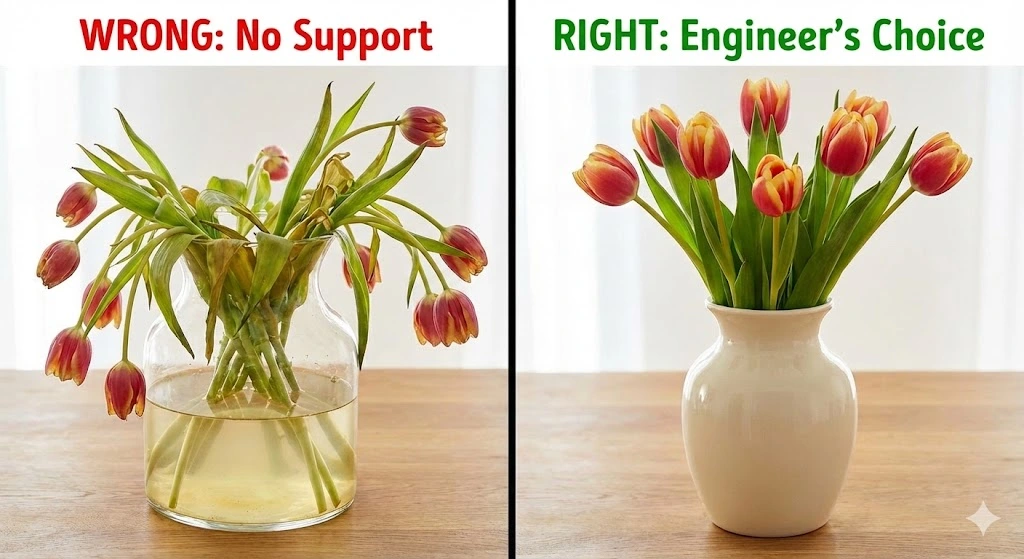
The Mistake: Buying a vase with a mouth as wide as a bucket. The Physics: When the opening is too wide, the flower stems have no lateral support. They splay outward due to gravity. To keep them upright, you are forced to cram more foliage in, or the stems cross over each other, crushing the “xylem” (the water-transporting tubes inside the stem).
The Solution: Look for the “Hourglass” or “Tapered” shape. The perfect vase should have a neck that is slightly narrower than the base. This acts as a natural collar, holding the stems together gently without strangling them. This structure allows the flowers to stand tall with their own turgor pressure, rather than leaning exhaustively against the glass.
2. Material Science: The War Against Bacteria
Why do cut flowers die? usually, it’s not because they ran out of water. It’s because bacteria clogged their drinking straws. Bacteria thrive in two conditions: Warmth and Light.
The Glass (Transparent) Trap: Clear glass vases are beautiful, but they are high-maintenance.
- The Problem: Sunlight penetrates the water. This promotes algae growth and warms the water, creating a perfect breeding ground for bacteria.
- The result: Cloudy, smelly water and clogged stems within two days.
The Ceramic (Opaque) Advantage: From a biological perspective, an opaque ceramic or porcelain vase is superior.
- The Benefit: It blocks 100% of UV light. This keeps the water temperature lower and inhibits bacterial replication. If you want your roses to last a week longer, choose the ceramic vase over the glass one.
3. The Hygiene Test: “The Hand Rule”
This is the most overlooked factor in vase buying. Rule: If you cannot fit your hand (or a scrubbing brush) inside to clean the bottom, do not buy it.
Biofilm is a slimy layer of bacteria that forms on the inner walls of a vase. If you don’t scrub it off physically, it stays there. When you put fresh flowers into a dirty vase, that dormant bacteria reactivates and attacks the new stems immediately.
- Avoid: Vases with complicated, twisted shapes or extremely narrow necks that make cleaning impossible. They are “single-use” items.
- Choose: Dishwasher-safe materials or wide-mouthed cylinders that allow for deep cleaning.
4. Center of Gravity: Structural Stability
You must anticipate the load. A dozen long-stemmed lilies or gladiolus flowers are surprisingly heavy and top-heavy.
The Tilt Test: Before buying, pick the vase up. Is the base thick and heavy? Cheap glass vases often have thin bottoms. When you add water and 500 grams of biomass (flowers) sticking 40cm out of the top, the center of gravity shifts dangerously high. A slight breeze from an open window or a nudge from a cat will send it crashing down.
The Engineer’s Choice: Look for “Weighted Bottom” vases. The glass should be visibly thicker at the base (at least 1-2 cm of solid glass). This lowers the center of gravity and anchors your arrangement.
5. The Golden Ratio: Proportion and Aesthetics
Finally, let’s talk about visual engineering. How do you know if a vase is the right size for your flowers? We use the Rule of Thirds.
Ideally, the vase should take up about one-third to one-half of the total height of the arrangement.
- The Math: If your vase is 20cm tall, the flowers should extend another 30cm to 40cm above the rim.
- The Trap: If you buy a vase that is too tall, the flowers will look like they are drowning. If it is too short, the arrangement will look top-heavy and chaotic.
My Professional Recommendation: Every household needs exactly two essential vases to cover 90% of scenarios:
- The Cylinder: A clear or ceramic cylinder (roughly 20-25cm tall) for rigid stems like roses or tulips.
- The Bud Vase: A small, narrow-necked vessel for that single, beautiful branch or flower you rescued from the garden.
Conclusion: It’s Not Just a Container
Next time you are shopping, don’t just look at the style. Look at the engineering. Ask yourself: Does this shape support the stems? Does this material block the light? Can I clean the bacteria out of this?
Your flowers are living entities. Treat them with respect by giving them a proper home, not just a pretty prison.