You walk out to your garden to check on your prize roses or your vegetable patch. You look closely at a new leaf and see them: dozens of tiny, soft-bodied insects clustered around the stem, sucking the life out of your plant.
Aphids. The bane of every gardener’s existence.
Your first instinct might be to grab a bottle of chemical insecticide. Stop. Put the poison down.
As a Forest Engineer, I prefer solutions that work with nature’s design, not against it. Today, I’m going to introduce you to a weapon that has existed for millions of years. It comes from the bottom of prehistoric lakes, it is completely natural, but for an aphid, it is the equivalent of crawling through a field of broken glass.
It is called Diatomaceous Earth (DE). And the short answer to your question is: Yes, it absolutely kills aphids. But you need to know how to use it.
Here is the engineering guide to using this geological marvel to wipe out your aphid infestation.
1. What on Earth is “Diatomaceous Earth”?
Before you use it, you must understand what it is. Diatomaceous Earth is not a man-made chemical powder. It is geology.
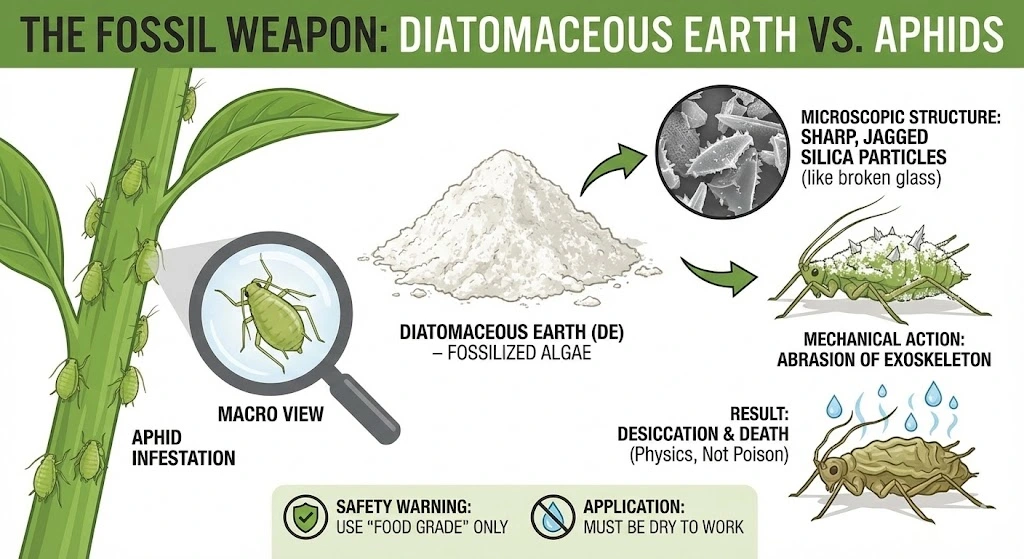
It consists of the fossilized remains of tiny, single-celled aquatic algae called Diatoms. These creatures lived millions of years ago, and their skeletons are made of nearly pure Silica. When mined and ground up, it looks like soft white flour to human eyes.
The Engineering Secret: Under a microscope, DE looks completely different. The particles are not round; they are jagged, cylindrical, and have razor-sharp edges. Imagine millions of microscopic shards of glass or coral. While it feels soft to your skin, to an insect with an exoskeleton, it is a lethal, abrasive trap.
2. The Mechanism of Death: Desiccation (Physics vs. Chemistry)
Chemical pesticides work by attacking an insect’s nervous system. The problem is that insects reproduce fast and can evolve resistance to these chemicals.
Aphids cannot build resistance to Diatomaceous Earth. Why? Because the attack is mechanical, not chemical. You cannot “evolve” resistance to being cut in half.
Here is the brutal engineering process of how it works on an aphid:
- Contact: An aphid crawls over a leaf or stem dusted with DE.
- Abrasion: The soft, waxy outer layer of the aphid’s body (the cuticle) gets sliced open by the microscopic silica shards.
- Absorption: DE is highly porous and acts like a super-sponge. Once the protective waxy layer is breached, the powder immediately starts absorbing the aphid’s essential body fluids (lipids and water).
- Death: The aphid doesn’t die from poison; it dies from Desiccation. It literally dries out within 24 to 48 hours.
3. The Protocol: How to Apply DE Correctly
This is where most gardeners fail. DE is not a “spray and forget” solution. It has rules.
Rule #1: It Must Be DRY to Work
Diatomaceous Earth only works when it is bone dry.
- The mistake: Applying it right before rain or right after watering.
- The science: If DE gets wet, the microscopic pores fill with water, and the sharp edges get soggy. It becomes useless mud.
- The protocol: Apply it only when rain is not in the forecast for at least 48 hours. Apply it in the late morning after the dew has evaporated off the leaves.
Rule #2: The “Dusting” Technique (The Best Method)
For aphids, the dry application is best because they are sitting right there on the leaves.
- Tools: Use a specialized powder duster (a small bellows-type device) or an old spice shaker with large holes.
- Action: Gently puff clouds of the dust onto the infested plants. You must coat both sides of the leaves. Aphids love to hide on the underside.
- The Look: Your plant should look like it has a light dusting of snow. You don’t need to bury it.
Rule #3: The “Wet Spray” Hack (The Sticker)
Wait, didn’t you say it has to be dry? Yes. But you can apply it wet to help it stick to the underside of leaves.
- The Recipe: Mix 2-4 tablespoons of DE into a gallon of water. Shake vigorously. Spray the plants, focusing on the undersides of leaves.
- The Magic: The DE is inactive while wet. But once the water evaporates, it leaves behind a fine, uniform film of dry powder exactly where the aphids are hiding.
4. Critical Safety Warnings: Read This First
WARNING 1: “Food Grade” ONLY
This is non-negotiable. There are two types of DE.
- Pool Grade (Filter Grade): This has been super-heated (calcined) and turned into crystalline silica (glass). NEVER USE THIS. Breathing it can cause permanent lung damage (silicosis).
- Food Grade: This is the natural, amorphous form. It is safe enough that it’s used in grain storage to keep bugs out of our food. This is the ONLY type you should use in your garden.
WARNING 2: Protect the Pollinators
DE is a non-selective mechanical killer. It doesn’t know the difference between a bad aphid and a good honeybee.
- The Rule: NEVER apply DE to the flowers or blossoms.
- Timing: Apply DE late in the evening when bees and butterflies have stopped foraging for the day. By morning, the dust will have settled.
Conclusion: Let Geology Do the Work
Gardening shouldn’t be a chemical warfare zone. Nature has provided us with powerful tools if we understand how to use them. By using Diatomaceous Earth, you aren’t poisoning your garden; you are setting a millions-of-years-old geological trap.
Put down the spray bottle. Pick up the fossils. And watch the aphids dry up and disappear.