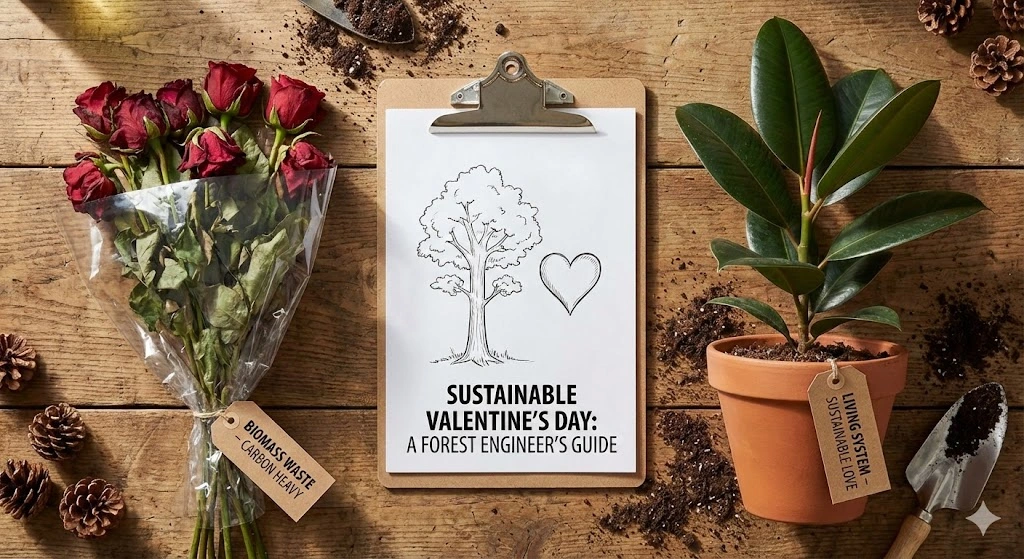
It is February 13th. The pressure is on. You are likely scrolling through a delivery app right now, hovering your finger over a button that says “12 Premium Red Roses – Next Day Delivery.”
Stop. Don’t press it.
As a Forest Engineer, I look at systems. I analyze efficiency, longevity, and environmental impact. And from an engineering perspective, a bouquet of cut flowers is one of the most inefficient, illogical, and environmentally destructive gifts you can buy.
When you buy cut flowers, you are essentially purchasing “Future Biomass Waste.” You are paying a premium for a product that has been severed from its life support system, chemically treated to look alive for 96 hours, and will inevitably end up in a landfill by next Tuesday.
This Valentine’s Day, I want you to change your mindset. Don’t give a gift that is dying. Give a gift that is living. Here is the science behind why you should ditch the bouquet and what you should buy instead.
The Engineering Audit: The Hidden Cost of a Rose
You might see a symbol of romance. I see a massive carbon footprint wrapped in non-recyclable cellophane. Let’s look at the data.
1. The Carbon Math Doesn’t Add Up
In February, roses do not grow naturally in Istanbul, London, or New York. They are grown in massive, heated greenhouses in the Netherlands or flown in refrigerated cargo planes from Kenya, Ethiopia, or Colombia.
- The Stats: A single bouquet of imported roses can have a carbon footprint of up to 6-7 kg of CO₂. To put that in perspective, that is roughly equivalent to driving your car for 20 kilometers just to hand someone a gift that will be dead in a week.
- The Energy: Maintaining a greenhouse at 20°C when it is 5°C outside requires massive amounts of natural gas. If they are flown in, the “Cold Chain” logistics (refrigerated trucks -> refrigerated planes -> refrigerated warehouses) consume immense energy to keep the blooms in suspended animation.
2. The Pesticide Cocktail
Unlike the food we eat, cut flowers are not strictly regulated for pesticide residues. To ensure a rose arrives in Istanbul without a single aphid or spot of mildew, growers often use a heavy cocktail of fungicides and insecticides. When you bury your nose in that bouquet to smell the “nature,” you are often inhaling a mix of synthetic chemicals.
3. The “Planned Obsolescence” of Love
In engineering, we try to avoid “single-use” systems. A cut flower is the ultimate single-use item. It has no root system. It cannot regenerate. It is a depreciating asset that hits zero value in 5 to 7 days. Why would you want your relationship represented by something with such a short expiration date?
The Solution: Give a “Living System” Instead
If you want to show love, give something that grows. A potted plant is an appreciating asset. It sequesters carbon (albeit in small amounts), cleans the air, and with the right care, it gets bigger and more beautiful every year.
Here are my top 3 “Forest Engineer Approved” alternatives that are perfect for a February 13th purchase.
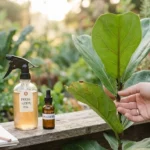
1. The “Structural Integrity” Choice: Ficus elastica (Rubber Plant)
If you want to make a bold statement, skip the flimsy flowers and go for wood. The Rubber Plant is a tank.
- Why it works: It has thick, glossy, dark green leaves that look almost architectural. It is incredibly resilient.
- The Symbolism: It represents strength and support. Unlike a rose that wilts if you look at it wrong, a Rubber Plant can survive a missed watering or a drafty window.
- Care Level: Low. Bright indirect light and water when the soil is dry.
2. The “Seasonal Engineer” Choice: Potted Spring Bulbs (Tulips/Hyacinths)
If your partner truly loves the color of flowers, don’t buy cut stems. Buy “forced” bulbs.
- Why it works: In February, you can find pots of Tulips, Hyacinths, or Daffodils that are just about to burst open. You get the same explosion of color and scent as a bouquet, but the plant is alive.
- The Trick: After they finish blooming, don’t throw them away! As a Forest Engineer, I love this part: You can plant the bulbs in a garden or a window box. They will go dormant and then bloom again next spring. It is the gift that literally reloads itself every year.
3. The “Legacy” Choice: A Tree Sapling Donation
If your partner is eco-conscious, the sexiest gift you can give isn’t a physical object—it’s a future forest.
- The Concept: Instead of spending $50 on dead roses, spend $50 to plant 10-20 saplings through a foundation like TEMA (in Türkiye) or One Tree Planted.
- The Engineering Impact: These trees will sequester tons of carbon, prevent soil erosion, and provide habitat for centuries. You aren’t just giving a gift for now; you are geo-engineering a better future. Print out the certificate, put it in a recycled envelope, and write: “Our love is growing a forest.” (Cheesy? Maybe. Sustainable? Absolutely.)
Maintenance Manual: Keeping the Love Alive
If you choose the potted plant route, don’t hand it over without instructions. That’s bad project management. Here is your quick “handover protocol” for a winter houseplant:
- Draft Protocol: It is February. Do not leave the plant in a cold car for hours, and don’t place it right next to a radiator. Extreme temperature shocks cause “leaf drop.”
- Hydration Logic: Most people kill plants with kindness (overwatering). Stick your finger 3cm into the soil. If it’s damp, do not water. Roots need oxygen just as much as they need water.
- Light Analysis: Place the plant near a window, but not touching the cold glass. The winter sun is weak, so they need all the photons they can get.
Final Verdict
Tomorrow is Valentine’s Day. You have a choice. You can buy a product that is designed to die, produced with heavy chemicals, and flown halfway around the world. Or, you can buy a living organism that grows, breathes, and lasts.
Be an engineer about it. Choose life. Choose sustainability. And please, put down the roses.