You went to the nursery on a sunny Saturday. You were dazzled. You saw a beautiful purple Salvia, so you bought one. Then you saw a yellow Daylily, so you grabbed one of those too. A Red Japanese Maple catch your eye? Into the cart it went.
You came home, dug a bunch of holes, and planted them all side-by-side. But now, you look at your garden, and it doesn’t look like the glossy magazines or the peaceful parks. It looks… messy. Disconnected. Restless.
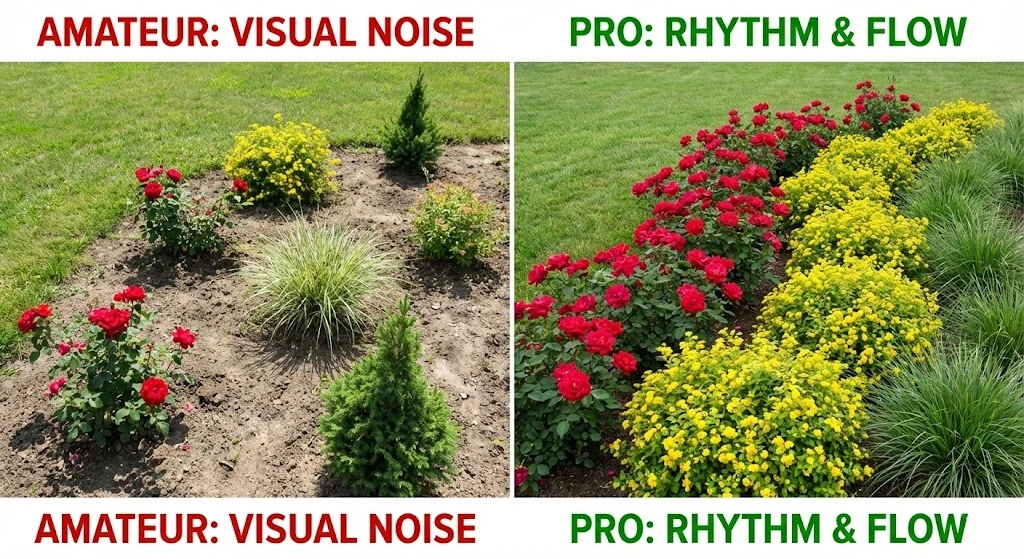
We call this “The Candy Store Effect” or “Polka-Dot Planting.” By treating plants like individual statues or collectibles, you are creating Visual Noise. The human eye bounces frantically from one shape to another, never finding a place to rest.
As a Forest Engineer and Landscape Designer, let me teach you the single most important rule that separates a $500 DIY garden from a $50,000 professional landscape: Repetition and Massing. Here is how to fix the chaos using simple engineering principles.
1. The Mistake: The “Zoo” Approach (One of Each)
Stop buying “one of this, one of that.” Nature rarely grows in singles. You don’t walk into a forest and see one fern, then one moss, then one wildflower. You see colonies. When you scatter single plants around, you create a collection of specimens, not a landscape. It makes a garden feel smaller, cluttered, and anxious.
The Pro Fix: Planting in Drifts Emulate nature. Force yourself to buy in bulk. Instead of buying 1 expensive, large Lavender, buy 5 smaller ones. Plant them together in a “Drift” or a “Swath” (a long, curved shape).
- Impact: A single flower is a dot. A group of 5 flowers is a “Splash of Color.” It creates a cohesive visual block that commands attention from 30 feet away.
- The Rule: If it’s smaller than a basketball, buy at least 3. If it’s smaller than a teacup, buy at least 7.
2. The Golden Rule: The Power of Odd Numbers (3, 5, 7)
This is the oldest trick in the design book, but few homeowners understand why it works. Always plant in Odd Numbers. Why not 2 or 4?
- Even Numbers (2, 4, 6): The human brain is wired to seek symmetry. If you plant two shrubs side-by-side, your brain instantly draws a line down the middle. It sees “Left vs. Right.” It creates a rigid, formal feeling that can look stiff or like “goalposts.”
- Odd Numbers (3, 5, 7): The brain cannot divide an odd number easily. It stops trying to count or divide, and simply perceives them as a Single Group. It feels natural, organic, and harmonious.
The Recipe: Take 3 identical plants. Arrange them in a loose, scalene triangle (not a straight line). Now you have created a “Design Element,” not just installed three plants.
3. The Hierarchy: Tiered Planting (The Choir Effect)
If all your plants are 2 feet tall, your garden looks like a flat green carpet. It lacks drama. You need 3D Engineering. Think of your garden bed like a choir photo or a stadium seating arrangement:
- Back Row (The Anchors): These are your structure. Tall evergreens, hedges, or large ornamental grasses. They provide the permanent green backdrop that makes the flowers in front pop. They also hide the fence.
- Middle Row (The Stars): This is where the texture happens. Your flowering shrubs, Hydrangeas, Roses, or Peonies go here. They are the main event.
- Front Row (The Spillers): This is crucial. Use low-growing groundcovers (like Creeping Phlox, Thyme, or Alyssum) at the very front. Let them spill over the edge of the bed onto the concrete path. This softens the hard lines of your hardscaping, making the garden feel established and overgrown in a good way.
4. The Glue: Repetition (Rhythm)
This is the final step that ties it all together. Once you have created a beautiful “Drift” of 5 yellow Daylilies on the left side of your garden… do it again on the right side.
Repetition creates Rhythm. Just like a song needs a chorus that repeats, a landscape needs recurring themes. When you repeat a specific plant or color at different intervals throughout the yard, you guide the viewer’s eye smoothly across the landscape. It tells the brain: “This is one single, unified place.”
Conclusion: Restraint is Luxury
The difference between “Cheap” and “Luxury” is not the price of the plant. It is Restraint. Don’t turn your yard into a botanical collection of 50 different species.
- Pick 5 varieties you love.
- Buy 7 of each.
- Plant them in masses.
Reduce the variety, increase the quantity. That is the formula for elegance.