
Here is the expanded, 600+ word version of the blog post. I have added a deeper explanation of the “Stratification” process (seed dormancy) and a specific step-by-step protocol to ensure the reader gets the timing exactly right.
The Lazy Gardener’s Secret: How to Plant the Perfect Lawn in February (Without Lifting a Shovel)
Category: Lawn Care / Agricultural Engineering Reading Time: 6 Minutes
It is February. The ground is hard, the air is freezing, and your neighbors are huddled inside, waiting for April to arrive so they can start digging up their muddy yards. You, on the other hand, could be fixing your lawn right now, in the freezing cold, with a cup of hot coffee in one hand and a bag of seeds in the other.
It sounds crazy to throw expensive grass seed onto frozen ground—or even directly on top of snow—but this is a proven agricultural technique called Frost Seeding. Farmers have used this method for centuries to revitalize pastures without using heavy machinery.
As a Forest Engineer, let me explain how to use soil physics to plant the perfect lawn without ever touching a rake or a shovel.
1. The Physics: Honeycomb Frost (Nature’s Plow)
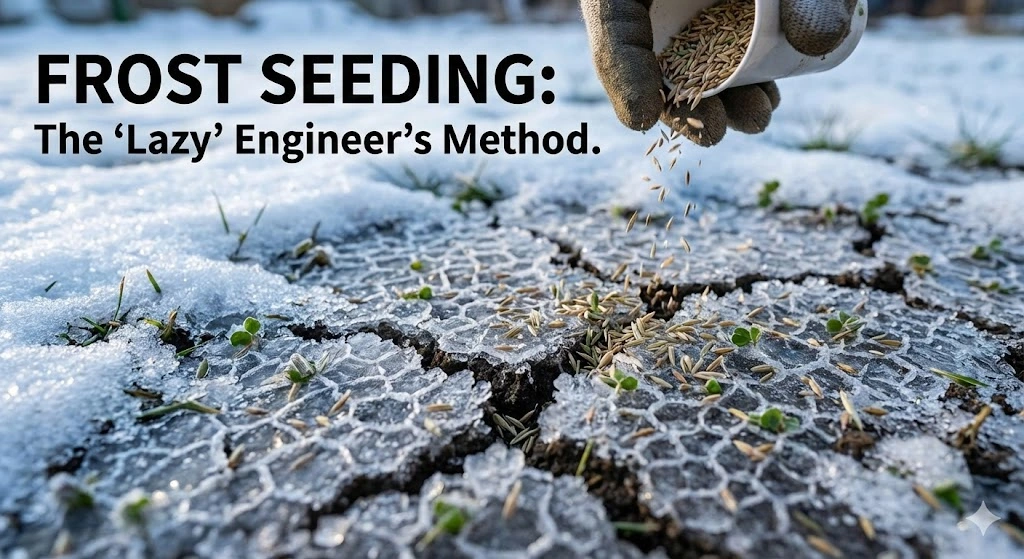
In late winter (February/March), the soil goes through a violent daily cycle. It freezes solid at night and thaws into mud during the day. When water freezes, it expands by approximately 9%. This expansion pushes the soil particles apart, creating millions of tiny cracks, fissures, and heaves on the surface. We call this structure “Honeycomb Frost.”
This is nature’s plow. It is free mechanical energy.
- Morning (The Application): You walk out and throw seeds onto the frozen, cracked ground.
- Afternoon (The Thaw): The sun comes out, the ice melts, and the soil collapses into a liquid mud. The seeds fall deep into those microscopic cracks.
- Night (The Lock): The temperature drops, and the soil freezes and expands again, locking the seeds tightly into the earth.
The Engineering Result: You achieve perfect “Seed-to-Soil Contact”—the #1 requirement for germination—without spending hours raking, aerating, or topdressing. The frost does the heavy lifting for you.
2. The Biological Advantage: Why It Beats Spring Planting
You might ask, “Why not just wait until April when it’s warm?” Because by April, you are already losing the biological race.
- The Head Start (Root Depth): Seeds planted via frost seeding are ready to germinate the second the soil temperature hits the trigger point (usually around 50°F / 10°C). They absorb the abundant early spring moisture and establish deep roots before the summer heat and drought hit. Spring-planted grass often has shallow roots that fry in July.
- Beating the Weed Clock: Your frost-seeded grass will germinate and claim the territory before most annual weeds (like Crabgrass) even wake up. In ecology, this is called “Competitive Exclusion.” You win the war before the enemy arrives.
- Cold Stratification: Many seeds have a hard, protective shell. They are biologically programmed to dormant until they experience a cold snap. The freezing and thawing action softens this hard shell, breaking dormancy and leading to significantly higher germination rates than dry seeds thrown in warm weather.
3. The Engineer’s Protocol: How to Do It
Timing is everything. You cannot do this in January (too cold, seed might rot) and you cannot do it in May (too warm). You need the “Freeze-Thaw” Window.
The Protocol:
- When: Late Winter (Right now). Look for a forecast where nights are below freezing (28°F / -2°C) but days are above freezing (40°F / 4°C).
- Where: This works best on bare spots or thinning lawns. Crucial Note: The seed must touch the soil. If your lawn is covered in a thick layer of dead leaves or thatch, this will fail. The seed will get hung up in the debris and never reach the dirt.
- The “Snow Hack”: If you have 1-2 inches of snow, throw the seeds right on top! It’s actually better.
- Visual Guide: You can see exactly where you have thrown the seeds (dark seeds on white snow), preventing bare patches.
- The Conveyor Belt: As the snow melts, it carries the seed down into the soil pores like a slow-motion hydraulic conveyor belt.
4. Best Seeds for the Job
Not all seeds are engineered for the cold. You must choose the right species.
- The Champion: White Clover. Clover seeds are small, round, dense, and hard. They drop into soil cracks perfectly and are incredibly cold-hardy. Plus, clover fixes nitrogen from the air, feeding your grass for free.
- The Runner Up: Cool-Season Grasses. Tall Fescue, Kentucky Bluegrass, and Perennial Ryegrass. These evolved in cold climates and thrive with this method.
- The Failure: Do NOT try this with Warm-Season grasses (Bermuda, Zoysia, Centipede). They are tropical in origin and the cold wet soil will rot them before they can sprout.
Conclusion: Work Smarter, Not Harder
Conventional gardening is about fighting nature with tillers, rakes, and chemicals. Engineering is about using nature’s existing forces. The freeze-thaw cycle is a powerful, free energy source happening in your backyard right now. Don’t let it go to waste. Grab your bag of seeds, put on your boots, and let the frost do the digging for you.