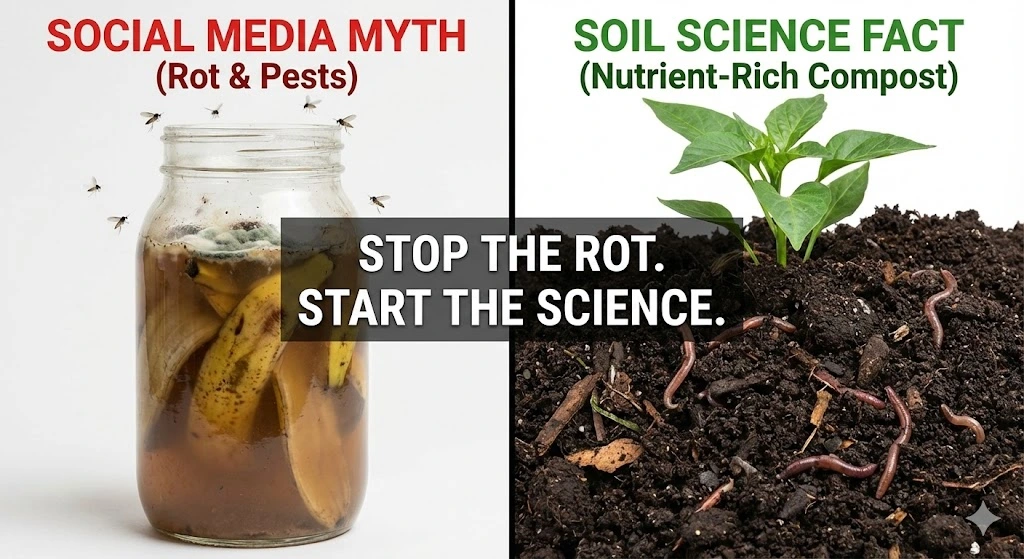
If you spend any time on Instagram or TikTok, you have undoubtedly seen the “magic hack.” The video usually goes like this: Someone chops up a banana peel, soaks it in a mason jar of water for 48 hours, and then pours the cloudy, brownish liquid onto their houseplant. The caption promises: “Free Organic Potassium! Watch your plants explode with growth!”
It sounds perfect. It’s free, it’s recycling, and it’s “natural.” As a Forest Engineer who specializes in soil microbiology, I need to be the bearer of bad news: Banana peel water is not fertilizer. It is a sugary, fermenting soup that invites rot, breeds pests, and can actually starve your plants of the nutrients they desperately need.
Here is the cold, hard science of why this “viral hack” is a disaster for your soil ecosystem.
1. The Physics: The Myth of “Leaching” Minerals
The premise of banana water is that soaking a peel releases Potassium (K) into the water. Biologically, this is nonsense. Potassium in a banana peel is not a loose powder sitting on the surface; it is locked inside the rigid cellular structure (cell walls) of the fruit skin.
Simply soaking a peel in cold tap water for two days does not break down these cell walls. It takes weeks of microbial decomposition or high heat to release those minerals. What actually leaches into the water? Sugar. Carbohydrates. Starch. When you pour that “tea” onto your soil, you aren’t pouring liquid potassium. You are pouring sugar water. Plants do not eat sugar. They produce their own glucose via photosynthesis. But you know who loves sugar water? Pathogenic fungi and bacteria.
The Engineer’s Analogy: If you soak a steak in water for two days, you don’t get a “protein shake.” You get rotting meat water. The protein stays in the steak.
2. The Chemistry: The “Nitrogen Lockdown” Effect
This is the most critical engineering principle in soil science that influencers ignore. It is called the Carbon-to-Nitrogen (C:N) Ratio.
Banana peels are almost 100% Carbon (sugar/fiber). They contain very little Nitrogen. When you add high-carbon, undecomposed organic matter (like banana sugar) to soil, the soil microbes go into a feeding frenzy to break it down. However, to do this work, microbes need fuel. That fuel is Nitrogen.
Since the banana water provides zero nitrogen, the microbes strip-mine the Nitrogen out of your soil to process the sugar you just dumped in. This is called “Nitrogen Immobilization.”
- The Irony: You thought you were feeding your plant. Instead, the microbes steal the existing food (Nitrogen) from the plant’s roots to eat the banana sugar.
- The Result: Your plant turns yellow (chlorosis) and stops growing because you accidentally starved it by giving it “junk food.”
3. The Biology: The Fungus Gnat Buffet
If you are wondering why your house is suddenly filled with tiny black flies hovering around your pots, look at your “magic water.”
Fungus Gnats (Sciaridae) thrive in damp, fermenting environments. They feed on fungus and decaying organic matter. When you pour sugary banana water into your potting soil, it immediately begins to ferment. It creates a sticky, sweet layer of decay on the soil surface. To a Fungus Gnat, this is a 5-star hotel. You aren’t feeding your Pothos; you are building a nursery for pests. Within two weeks, hundreds of larvae will be eating your plant’s roots.
The Smell Factor: Indoor plants should smell like earth or nothing at all. Banana water eventually rots anaerobically, releasing a faint smell of garbage or vinegar. This attracts ants and fruit flies into your kitchen.
4. The Engineer’s Solution: Composting is the Only Way
So, are banana peels useless? Absolutely not! They are full of Potassium, Calcium, and Magnesium. But to unlock those nutrients, you must follow the laws of physics. The peel must be decomposed first.
There are no shortcuts in soil engineering.
- The Wrong Way: Soaking fresh peels in water (Anaerobic / Sugar extraction).
- The Right Way: Putting peels in a compost bin, worm farm, or burying them deep in an outdoor garden bed (Aerobic / Mineralization).
Once the peel turns into dark, crumbly soil (humus), the sugar is gone, and the Potassium is finally available for the plant roots to absorb.
Conclusion: Stop the Jars
If you want to feed your houseplants, buy a bottle of balanced, organic liquid fertilizer (like Seaweed extract or Fish Emulsion). It costs $10 and actually works. Stop the jars. Stop the rot. Your plants don’t want a smoothie; they want soil science.